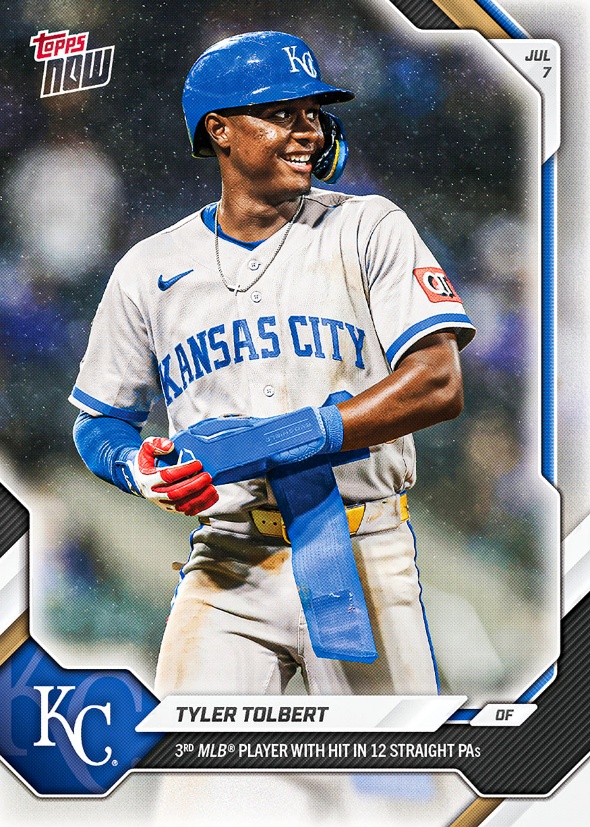
From July 4 to July 7, Royals fans were treated to a Tyler Tolbert hit parade that tied two baseball records of the modern era (1900 to date):
Back-to-back 5-hit games. Hi Myers (1917) and Roberto Clemente (1970).
Getting a hit in 12 consecutive plate appearances. Johnny Kling (1902) and Walt Dropo (1952).
Topps issued a “NOW” baseball card as of July 7 for the 12-hit streak.
Congratulations Tyler! And thanks for the reminder about the Kansas Citian who established the 12-hit record 124 years ago. Johnny Kling has had some cameos in Hot Stove, but today he gets headline coverage.
Johnny Kling – Native of KC: Johnny Kling was born in Kansas City in 1875. In his teenage years, he showed promise on the baseball diamond and in the pool hall. He became a world champion in both.
Kling’s excellence at baseball was noted in the Kansas City Journal when he was only 14 years old (July 1890). He played for various local amateur, semi-pro and pro teams during the 1890s, including two lengthy stints with Schmelzer’s, a Kansas City sporting goods house where he worked when not playing. In September of 1900, while playing for a minor league team in St. Joseph, Missouri, Kling was signed by the Chicago Orphans (to be rebranded as the Cubs in 1903).
[Schmelzer’s Trivia: Hot Stove friend Chip Schmelzer (RIP, 2024) was the great-great grandson of John F. Schmelzer, the founder of Schmelzer’s in 1857. The sporting goods company sponsored many local teams at the turn of the century, including the integrated All-Nations team owned by J.L. Wilkinson in the 1910s. Many of the Black players from All Nations joined Wilkinson’s Kansas City Monarchs when the first Negro League was formed in 1920. More on that story and Chip’s memorabilia collection can be found in Hot Stove #49.]
Chicago Cubs Catcher: When Kling joined the Orphans/Cubs in 1900, one of the primary catchers was Frank Chance who was injury prone because of poor handling of foul tips. The addition of Kling allowed Chance to move to first base in 1901. This was serendipity at its best. Combined with shortstop Joe Tinker and second baseman Johnny Evers, Chance became part of the famed double play combination of “Tinker to Evers to Chance,” forever part of baseball lore because of a poem written by Franklin Pierce Adams, a New York Giants fan lamenting how the trio ended rallies:
These are the saddest of possible words:
“Tinker to Evers to Chance.”
Trio of bear cubs, and fleeter than birds,
Tinker and Evers and Chance.
Ruthlessly pricking our gonfalon bubble,
Making a Giant hit into a double –
Words that are heavy with nothing but trouble:
“Tinker to Evers to Chance.”
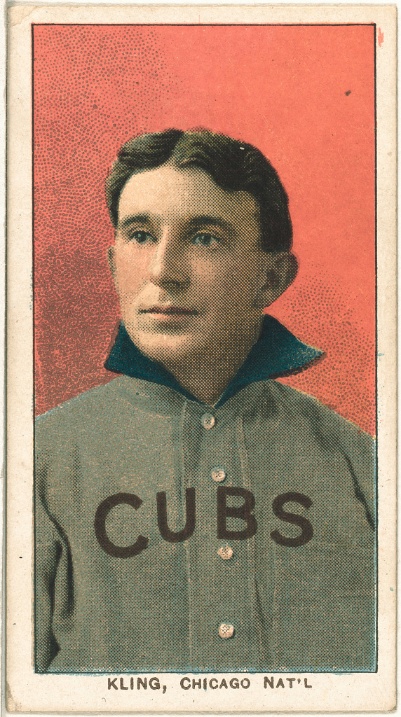
Kling soon became the primary catcher for the team. Nicknamed “Noisy” for his constant chatter, he was considered by many to be the best catcher in baseball for the 1900s. He handled pitchers well and had a rifle arm to cut down base stealers. He also had a decent bat (a career OPS+ of 100) and was skilled at baserunning. In 1902, he established the MLB record of getting a hit in 12 straight plate appearances.
The Cubs became the first baseball dynasty of the 20th century. They won three straight NL pennants in 1906, 1907 and 1908 and back-to-back World Series in 1907 and 1908. They then went 108 years before again winning a World Series in 2016.
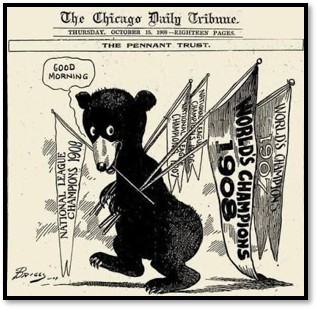
In 1909, Kling sat out the season to shoot pool. The Cubs, no doubt missing their star catcher, lost the 1909 pennant to the Pirates.
In 1910, Kling returned and the Cubs again won the NL pennant before losing the World Series.
The Cubs traded Kling to the Boston Braves in 1911, and he finished his 13-year MLB career with Cincinnati in 1913.
The Cubs dynasty team had four Hall of Famers – Tinker/Evers/Chance and pitcher Mordecai “Three Finger” Brown. Kling was a major contributor to the team and was seriously considered for the Hall of Fame when it was established in 1936. Of the thousands of players who had played up to that time, 38 received multiple votes in the election. Kling was 28th in vote count. Five were inducted from that election (Ruth, Cobb and three others), and those ranked 6 to 27 all later made it to the Hall of Fame. Same thing happened in 1937 when Kling was 22nd in the voting. Three were enshrined that year and the other 18 above him later made it to Cooperstown. Kling continued to receive votes for a few years but eventually faded from consideration.
Billiards Champion and Entrepreneur: Kling’s pool hall talent translated to financial success. In the offseason after the Cubs won the 1908 World Series, Kling won the World Pocket Billiards Championship. Rather than playing baseball in 1909, he toured the country playing high stakes matches. He made much more money than he had at baseball where the reserve clause held down salaries. After he lost his billiards title during the following winter, Kling returned to baseball for the 1910-1913 seasons. But his future was in pool.
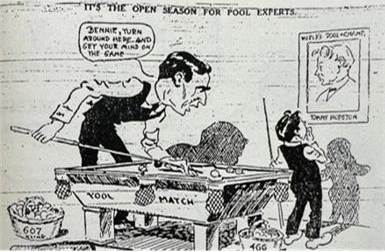
Although Kling returned to baseball, he was actively developing a pool hall in Kansas City with his nephew Bennie Allen. Under Kling’s mentorship, Bennie became a 6-time World Straight Pool Champion. The competition between uncle and nephew for best in Kansas City was noted in this cartoon in the Kansas City Star:
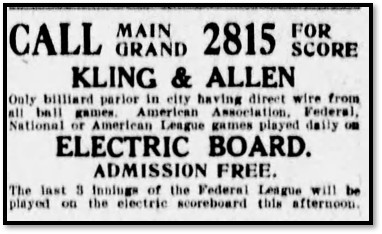
Kling and his nephew opened a nationally famous pool emporium called Kling and Allen’s Billiard Parlor. It was a draw for pool stars and hustlers from around the country (Willie Mosconi, Minnesota Fats, etc.) and hosted national tournaments. A popular feature was the parlor with an electronic scoreboard to follow baseball scores around the country (an early form of a sports bar).
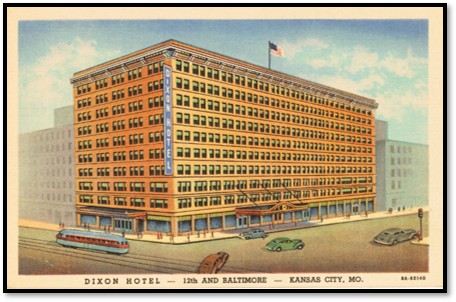
The pool emporium occupied the second and third floors of the Dixon Hotel, which was also owned and managed by Kling and Allen. The 39 pool tables included “Big Bertha,” an oversized 10’ x 5’ table crafted by Brunswick in 1913 from rare Russian wood. Players from around the country came to play on Big Bertha. When the emporium closed after Kling’s death in 1947, Big Bertha ended up in a basement in Leawood for many years but is now in use at Raytown Recreation (see this post from two months ago in Kansas City Magazine).
Brunswick also named one of its elite commercial lines after Kling, and manufacturers today still make “Kling” tables based on the original design. As is the case with his baseball history, Kling is still known a century later in the pool world. Below, from a Billiards Buzz issue in 2022.
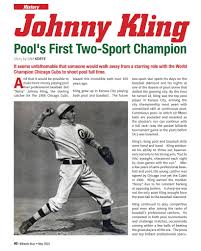
Kling’s financial success helped him with a new endeavor, purchasing the local minor league team.
Kling as Kansas City Blues Owner: George Muehlebach, namesake of a KC hotel and brewery, bought the minor league Kansas City Blues in 1917. In 1923, he built Muehlebach Field at 22nd and Brooklyn to serve as the home field for the Blues and the Kansas City Monarchs. The franchise was very successful in the 1920s, but the Depression hurt attendance and prompted Muehlebach to sell the team after the 1932 season to a group led by baseball great Tris Speaker and actor/comedian Joe E. Brown. To help provide financing, local investors were brought in, including Tom Pendergast (thanks to Hot Stove’s Pendergast Editor Pat O’Neill for sending a copy of T.J.’s stock certificate).
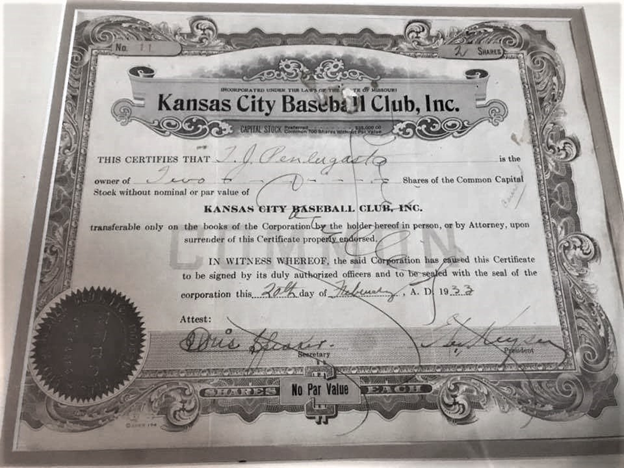
At the end of a miserable 1933 season, the one-season owners sold controlling interest in the Blues to Johnny Kling. As reported in the Kansas City Star, Kling owned 71% of the shares with the balance being owned by Speaker (18%) and the local investors (11%). I don’t know if Kling acquired the balance but note that T.J.’s certificate was “Cancelled” in handwriting across the document.
One of Kling’s first acts was to desegregate the stadium, removing the “White” and “Colored” signs from the stands. Kling’s action was a rare occurrence in the baseball world of the 1930s.
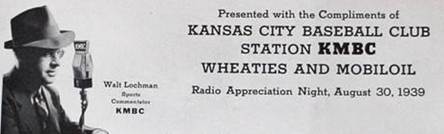
Kling improved the team and attendance rebounded, no doubt aided by another unique ownership decision. My initial source on this was my Van Horn High School classmate Bill Lochman (RIP, 2024). Bill’s father Walt Lochman started in radio in 1927, working for various stations as a singer, announcer, talk show host and administrator. In 1935, he approached Johnny Kling to get permission to broadcast Blues games. Kling shared the worry of other baseball owners who were hesitant to employ radio because they thought it would hurt attendance. But Kling agreed to a 10-game test, and it was a smashing success. More details in Hot Stove #21.
In 1937, Kling sold the Blues and Muehlebach Field to Yankee owner Jacob Ruppert who rebranded the stadium (Ruppert Stadium) and reinstated the White and Colored signs. Walt Lochman continued to broadcast, ultimately covering over 1,000 Blues games through 1942.
Was Johnny Kling Jewish?: During Kling’s lifetime, many considered him to be Jewish. In 1904, he married Lillian May Gradwohl who was Jewish, and they were married by Kansas City Rabbi Harry H. Mayer of Temple B’nai Jehudah.
Players, managers and the press often assumed Kling was Jewish. In 1934, newly appointed National League president Ford Frick told the Jewish Telegraphic Agency, “Probably the greatest Jewish player ever in the leagues was Johnny Kling, catcher and the ‘Brains’ of the famous old Chicago Cubs of the Frank Chance era.” In a 1942 interview with the Detroit Jewish News, Frick aligned Kling with Harry Danning and Hank Greenberg as Jewish stars.
John McGraw, manager of the New York Giants from 1901 to 1932, lamented that he had been unable to recruit a Jewish star like Johnny Kling to help draw Jewish fans to the Polo Grounds. “The greatest catcher, next to Bresnahan, that I have known during my active years as a manager was Johnny Kling. Johnny is a Jew, but so great was he as a catcher for the Cubs that many never thought to inquire as to his religion or faith.”
After McGraw retired, his theory of attracting Jewish fans was proven when Harry “The Horse” Danning joined the team in 1933. One of those fans was Morris Margolies who at age 8 in 1930 moved with his family from Jerusalem to the Bronx. He became interested in baseball which proved to be a good way to acclimate to his new American life. But he was not sure which New York team should be his favorite (Yankees, Giants or Dodgers). He learned that only the Giants had a Jewish player (Harry Danning). This made the boy (and the rabbi he became) a lifelong Giants fan even after the family moved to Kansas City and the Giants relocated to San Francisco. More on Rabbi Margolies and his love of baseball is in Hot Stove #32. The rabbi’s journalist son Dan Margolies shows up in my inbox every morning with his excellent Substack posts.
In 1969, a researcher contacted Kling’s widow, and she said Kling was Lutheran (she said at another time he was Baptist). But her claim has been questioned by Kling’s biographer Gil Bogen. He believes she was trying to protect Kling from antisemitism in Hall of Fame consideration. Bogen goes to great lengths in his 2006 book to persuade his readers that Kling was Jewish.
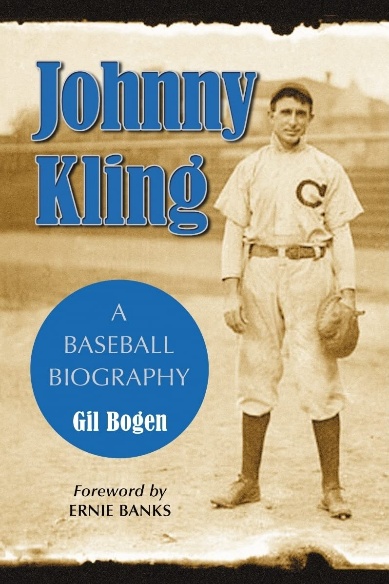
I checked the archives of the Kansas City Jewish Chronicle and found several hits on Johnny Kling. The oldest was from 1963 and paired Kling with Sandy Koufax.
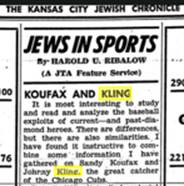
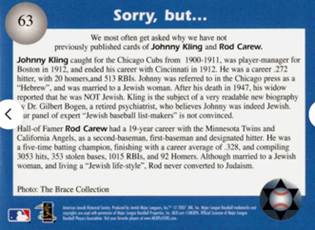
The Chronicle covered the widow’s Lutheran claim in 1969, and Rick Hellman of the Chronicle has noted the controversy at least three times, including a review of Bogen’s book in 2006 and a follow up story in 2007 about the issuance of a new Kling baseball card by the American Jewish Historical Society. Note the question mark after Kling’s name…
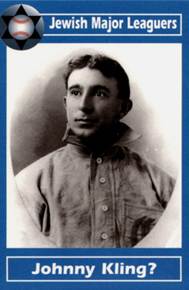
…and the explanation on the reverse.
Pat O’Neill on Johnny Kling: Joining me in the Johnny Kling fan club is Pat O’Neill. In the book he wrote with Tom Coffman (Ted Sullivan: Barnacle of Baseball), the authors credit Ted Sullivan with going to St. Joseph in 1900 to scout and sign Johnny Kling for the Chicago Orphans/Cubs. And when I wrote in 2022 about Walt Lochman, Johnny Kling and baseball on the radio, I heard from Pat about his own Kling story he was posting on Facebook. And now it’s posting in Hot Stove…
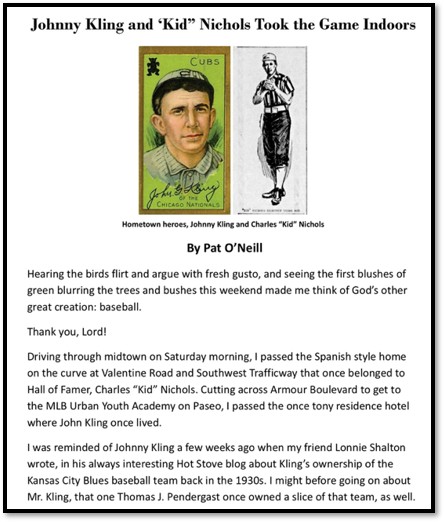
Read the rest of Pat’s piece at this link.
John Wathan and Johnny Kling: Earlier this month at a ceremony at the K, John Wathan was inducted into the Kansas City Royals Hall of Fame. This is a well-deserved recognition for his 47 years with the Royals as a player, manager, coach, scout and broadcaster. This also introduces yet one more piece of Kling trivia. Before the 1982 season, these players were the leaders for the most steals by a catcher in a season:
30 – Ray Schalk (1916)
25 – Johnny Kling (1902)
25 – Roger Bresnahan (1906)
24 – Ray Schalk (1914)
23 – Johnny Kling (1903)
In 1982, John Wathan passed them all with 36 steals. That remains the MLB record for a catcher.
Lonnie’s Jukebox – Media Tech Museum Edition: Rita spotted this cartoon that cleverly captures the evolution of music listening from vinyl to Spotify.

This also serves as an introduction to a new museum in Kansas City that opened in the Crossroads on June 1, the Media Tech Museum.

The museum features the personal collection of a thousand items assembled since 1983 by KC’s Jon Trozollo (below, with some of his jukeboxes).
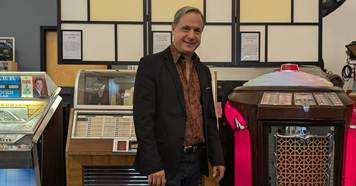
The museum exhibits capture the evolution of every major era of media communication, from telegraphs to telephones to radios, televisions, phonographs, audio and video tapes and recorders, film, still and video cameras. To get a feel for the museum experience, check out the website and these brief mini-tour news clips from KCTV and KSHB.
Rita and I give it two thumbs way up!
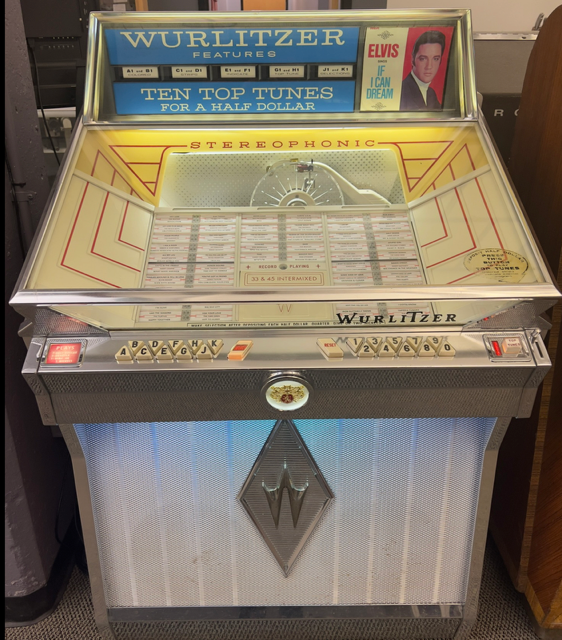
Jon’s Jukebox: One of Jon Trozollo’s favorites is this Wurlitzer 2610, a classic from 1962 that holds 50 45-rpm vinyl records to deliver 100 selections. He says it is celebrated by collectors for introducing the first-ever Wurlitzer title board layout capable of displaying full record picture sleeves (e.g., Elvis below).
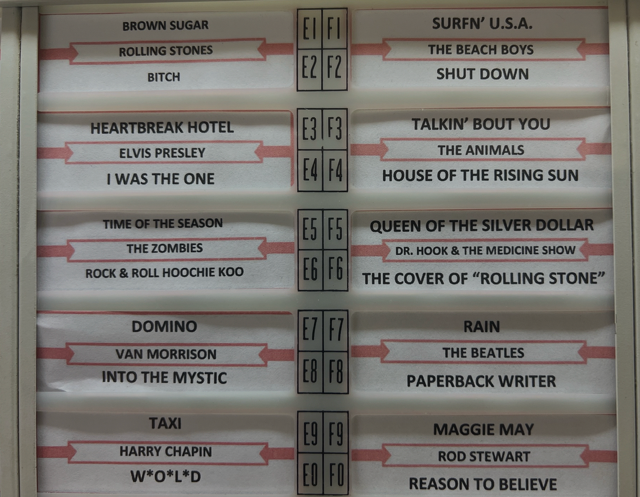
Here is a closeup of part of the playlist.
Below is the “play” button and…
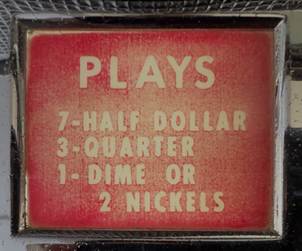
…I just put in a Franklin half-dollar and a Washington quarter to play the following 10 tunes from Jon’s Jukebox…
“Hey Jude” by the Beatles
“You’ve Got a Friend” by James Taylor
“House of the Rising Sun” by the Animals.
“Uptown Girl” by Billy Joel
“Happy Together” by the Turtles.
“Me and Bobby McGee” by Janis Joplin.
“For Your Love” by the Yard Birds.
“Heartbreak Hotel” by Elvis Presley.
“Sealed With a Kiss” by Bobby Vinton.
“Time of the Season” by the Zombies.
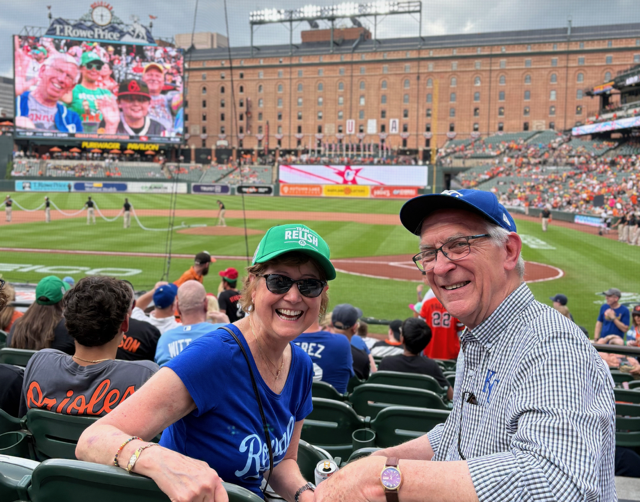
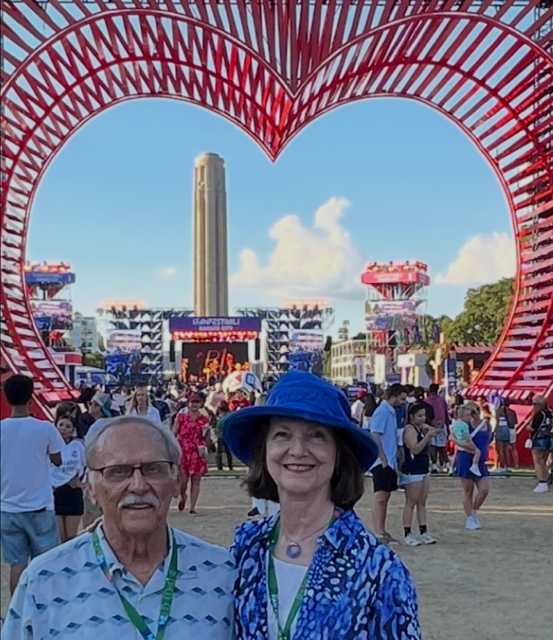
Walk-Off Photos – Saturday, July 11, 2026: A week ago, Rita and I attended Fanfest on the day of the last World Cup game in Kansas City. Kudos to the local organizers for a great show.
While we were at Fanfest, Leslie and Jeb Bayer were in Baltimore watching the Royals play the Orioles at Camden Yards. These are true blue fans who also attended a Royals game against the Mets in New York before heading to Baltimore.