Kansas City has earned its reputation as the sports stadium design capital of the world. And 2026 has provided some great examples.
In April, the Royals released renderings of their future stadium at Crown Center. The design architecture firm is KC-based Populous.

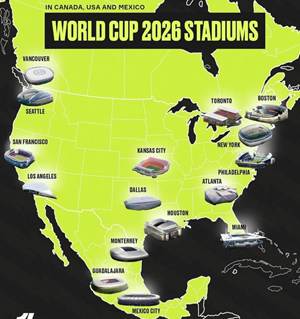
Over the summer, the World Cup was played in three North American countries in 16 stadiums. Kansas City architects designed 13 of those stadiums.
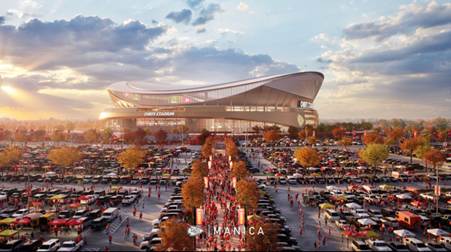
In July, the Chiefs released renderings of their future stadium in Kansas. The design architecture firm is KC-based Manica. In addition, KC-based HNTB will be the architect-of-record for the project.
Why Kansas City?: My version of the story begins six decades ago with the Democratic primary election in August of 1966. In a landslide victory, the Committee for County Progress ousted the old-line political factions that had long controlled Jackson County.
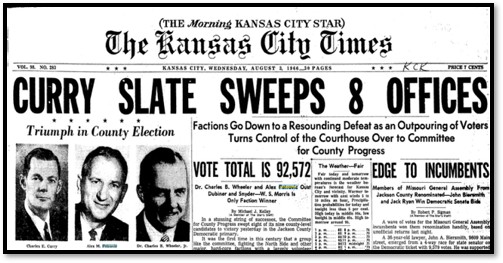
The CCP candidates easily won in the general election in November, including all three members of the county administrative court: Presiding Judge Charles Curry, Eastern Judge Alex Petrovic and Western Judge Charlie Wheeler. When they took office in early 1967, the judges quickly moved to leverage their political success by asking voters to approve a major infrastructure package that included a new home for the Kansas City Chiefs and the Kansas City A’s (or an expansion team if the A’s moved).
Early stadium plans assumed a multi-purpose stadium, possibly paired with an arena for basketball as shown below. Several similar stadiums had recently been built, including the Astrodome in Houston, Veterans Field in Philadelphia, Three Rivers Stadium in Pittsburgh, Busch Memorial Stadium in St. Louis and Riverfront Stadium in Cincinnati.
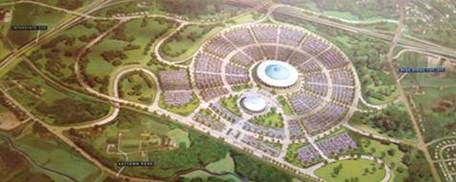
But Denver architect Charles Deaton presented a novel layout that enamored Chiefs owner Lamar Hunt and GM Jack Steadman: two adjacent stadiums with sight lines and capacity to match the sport. Steadman was already concerned about capacity because he thought the Chiefs could draw 75,000 fans. Another key factor was the Chief’s frustration with the uncooperative A’s owner Charlie Finley who was still threatening to relocate. With the baseball situation in limbo, the Chiefs and the Jackson County Sports Authority approved the Deaton plan, including a sliding roof to cover either stadium.
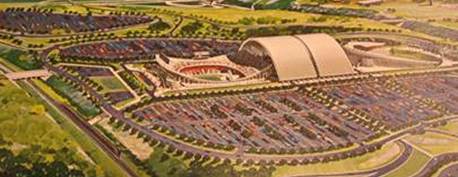
The voters approved the bonds on June 27, 1967. Deaton’s design (sans roof) was implemented by project architect Kivett and Myers of Kansas City. Arrowhead opened in 1972. The expansion Kansas City Royals began play in their new stadium in 1973.
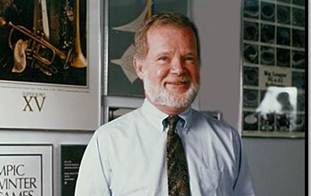
Ron Labinski – The Godfather of Modern Stadium Design: One of the Kivett and Myers architects working on Arrowhead was Ron Labinski, then in his early 30s. Upon completion of the two stadiums at the Truman Sports Complex, Labinski envisioned a new future of stadium construction – replacement of the existing multi-purpose “concrete donuts” with two stadiums for football and baseball.
And the market was ripe. The sightlines and capacity of the dual stadiums in Kansas City were a hit. Labinski made a list of expiring leases on existing stadiums and began attending NFL and MLB owners meetings to market his services. He left Kivett and Myers and began developing a team of sports architects at a small firm and then moved the group to Kansas City’s HNTB to market from a bigger platform.
In 1983, Labinski and his team left HNTB to form HOK Sport, a sports-only division of the national HOK architecture firm. The single-sport stadium trend was accelerating and business boomed. Two other stadium enhancements were also underway in Baltimore and Miami.
Camden Yards in Baltimore: One of HOK Sport’s first projects was for a minor league team in Buffalo NY (Labinski’s birthplace). Pilot Field opened in 1988 and incorporated architectural detail from the neighboring historic district to create the first “retro-classic” park in an urban setting. It felt like an old ballpark within the street grid of the city (like Fenway and Wrigley), but with modern amenities and sightlines.
The concept was then applied in downtown Baltimore where HOK Sport worked with the Orioles to create the first MLB retro-classic park. Opened in 1992, Oriole Park at Camden Yards was beautifully framed by historic buildings, notably the B&O Warehouse beyond right field.
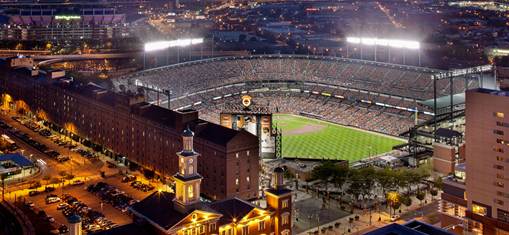
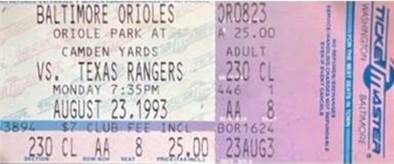
Praise came from everywhere. Baseball fans from around the country came to see the new jewel box of a park. Rita and I were among them in 1993 (ticket stub below). Yes, we loved it.
Camden Yards started a trend that continues to this day. When Rita and I finished our bucket list of seeing all 30 MLB stadiums (reported in Hot Stove #278), our four favorites were downtown retro-classics incorporating the vistas beyond the stadiums. In San Francisco, the bay. In Pittsburgh, the Roberto Clemente Bridge. In San Diego, a stadium shoehorned into downtown. In Baltimore, the setting in the harbor and the B&O Warehouse. Honorable mention: Denver’s mountain views.
And coming up, Kansas City. A new stadium at Crown Center integrated into the natural elevation and street grid, framed by the World War I Memorial, Union Station and the downtown skyline. Exciting!
Joe Robbie Stadium in Miami: While marketing stadium design to team owners, Labinski asked questions about the business side of the operations – concessions, premium seating and insight on revenue streams and fan amenities. A good example of this was his work with Joe Robbie who was planning a new stadium in Miami for his NFL Dolphins. Although enclosed luxury suites had previously been used in stadiums, Labinski pitched a new category of high-revenue seating. As recounted in a 2010 article in Sports Business Journal…
At a morning meeting at Robbie’s penthouse apartment at the Polo Club in Miami Beach, Labinski unveiled a design that he had pitched unsuccessfully to two Canadian Football League teams a few years earlier. To protect fans against the brutal winters in western Canada, Labinski proposed a mezzanine section that would be backed by heated and air-conditioned space, dressed out similarly to the lobby of an upscale hotel, with bars and areas to sit and talk. Labinski showed Robbie the math. He could raise $10 million a year from 200 suites priced at an average of $50,000. By tacking on a club level with 10,000 seats priced at $1,000, he could add another $10 million. Doubling the contractually obligated income from premium seats was enough to get Robbie the financing he needed to move forward on the project. A new category of seating was born. “From that stadium forward, we haven’t built a major project without club seats,” Labinski said. “I only wish I had patented the concept.”
When Joe Robbie Stadium opened in 1987, it featured 10,214 club level seats forming a teal band separating the upper and lower orange decks.
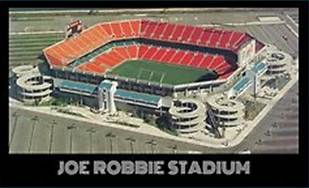
Even Ron Labinski might not have foreseen how far his idea would go. SoFi Stadium in Los Angeles, opened in 2020, has 70,000+ capacity with about 20% of the seats located in multiple pricing levels of luxury suites and premium club seats. That 20% of the seating generates over 50% of ticket revenue for SoFi. Rams owner Stan Kroenke can thank Ron Labinski for this winning business model. Click here for the detailed suite map.
Growth of the Specialty: When Ron Labinski and his team left HNTB for HOK Sport in 1983, his new firm still had a competitor. HNTB restocked its staff with sport specialists, and in 1988, some of them left to open a KC office for Minneapolis-based Ellerbe Becket. This meant that the three largest sports architecture groups in the world as of 1988 were based in Kansas City.
The stadium (and arena) boom continued around the world. College and pro. Other sports, like soccer. There was a lot of work for sports architects, so more competitors naturally joined in, often by opening Kansas City offices and hiring away specialists from local firms. As headlined by Forbes Magazine in 2019:

In anticipation of the 2026 World Cup games in Kansas City, AIA Kansas City (the local chapter of the American Institute of Architects), released a fact sheet and history on Kansas City’s “Architects of the Game.” It includes these incredible numbers on the share of stadiums designed by the 20+ firms based in Kansas City…
- 70% of NFL stadiums
- 80% of MLB ballparks
- 90% of NBA and NHL arenas
- 66% of MLS stadiums
- 100% of stadiums built specifically for women’s professional soccer, including Kansas City Current’s CPKC Stadium
- Plus 4,000+ college and university sports facilities worldwide
[Hot Stove Note: CPKC Stadium is featured prominently in this week’s opening episode of Season 4 of Ted Lasso. Many other familiar KC sites are in the episode (including our condo building in the Plaza shots). Jason Sudeikis (a/k/a Ted Lasso) has delivered a beautiful love letter to his hometown.]
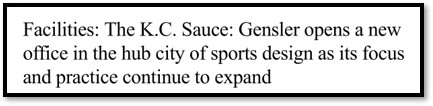
Ron Labinski retired in 2000. In 2009, the management team at HOK Sport bought out it’s HOK parent and became an independent firm known as Populous. After a non-compete period, HOK (St. Lous-based) reentered the business by opening a new KC sports office. Ellerbe Becket remains in KC but is now part of AECOM. HNTB is still HNTB. When San Francisco-based Gensler opened a KC “sports studio” in Kansas City in 2024, it’s CEO explained:
“The epicenter of sports [architecture] talent is in Kansas City. So, it’s really an opportunity to connect with the talent in that marketplace, and no better way to do it than to have a physical space that allows people like Greg and others to join into our firm and be a part of the growth of our practice that really is a globally focused practice with a multi-location approach.”
Or as headlined in the Sports Business Journal and adding some barbecue flavor…
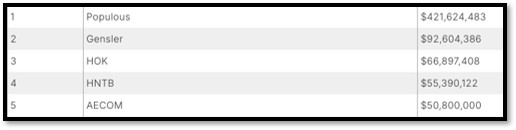
In October of 2025, Building Design + Construction listed the top 135 sports facility architecture firms (based on 2024 sports facility revenue). The top five…
All thanks to…
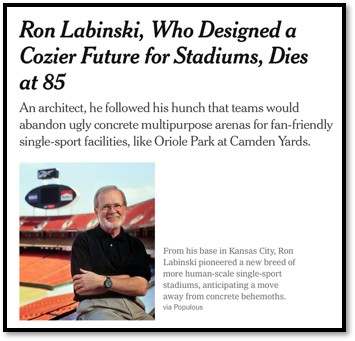
Ron Labinski (RIP): Ron Labinski died on January 1, 2023, at the age of 85. What a legacy!
The New York Times:
The Washington Post:
The Wall Street Journal:
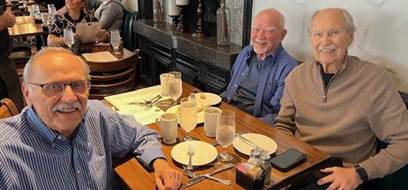
A Personal Note – Brian Firkins (RIP): My high school classmate Brian Firkins (Van Horn ’59) died last week (obituary here). Brian was an architect, and his career included stints at HOK, HNTB and Populous. He was involved in some of Kansas City’s largest projects (e.g., Town Pavillion, Bartle Hall expansion and Union Station renovation) and several stadiums (e. g., Oakland Coliseum, Marlins Park, Busch Memorial Stadium and the renovation of Kauffman Stadium). Below, from last year, with Brian (right) and our fellow Van Horn classmate Jim Kirkham (center).
RIP Brian.
Political Trivia: And now to return to the first step in my story. In that 1966 election, the Committee for County Progress was successful in eight of their nine county races.
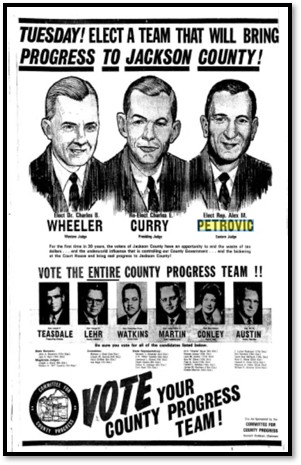
The three administrative judges (Charles Curry, Charlie Wheeler and Alex Petrovic) were lauded in Hot Stove #97 for their efforts in creating the Truman Sports Complex. Curry later became DNC treasurer. Wheeler was a two-term mayor of Kansas City from 1971 to 1979. Petrovic became the spokesperson for St. Joseph Hospital.
Prosecutor Joe Teasdale became governor in 1977. Collector George Lehr was elected presiding judge in 1970 and state auditor in 1974. Circuit Clerk Bruce Watkins, the first Black elected countywide, became a two-term KC councilman and candidate for mayor. Ralph Martin, running for public administrator and the only one not elected in 1966, came back to be a three-term Jackson County prosecutor. County Clerk Berniece Conley was the first woman elected countywide. Recorder of Deeds Bill Austin held his office until it was phased out by the new county charter.
Lonnie’s Jukebox – MLB Stadium Victory Songs: Most MLB teams have a celebration song played after the last out of a home victory. Here are some of them.
“New York, New York” by Frank Sinatra. At Yankee Stadium.
“New York Groove” by Ace Frehley. At Citi Field, home of the Mets.
“Cleveland Rocks” by Presidents of the United States of America. The link is to the song opening the Drew Carey show from 1997 to 2004. In the video, they dance in front of Jacobs Field, home of the Indians. The stadium and team are still there, but it’s now the Guardians at Progressive Field.
“Fire” by Jimi Hendrix. Played at T-Mobile Park in the singer’s hometown of Seattle.
“(I Left My Heart) In San Francisco” by Tony Bennett. In Oracle Park where long homers to right field end up in San Francisco Bay.
“I Love L.A.” by Randy Newman. At Dodgers Stadium.
“Dirty Water” by the Standells. At Fenway in Boston.
“You Make My Dreams” by Hall and Oates. At American Family Field in Milwaukee.
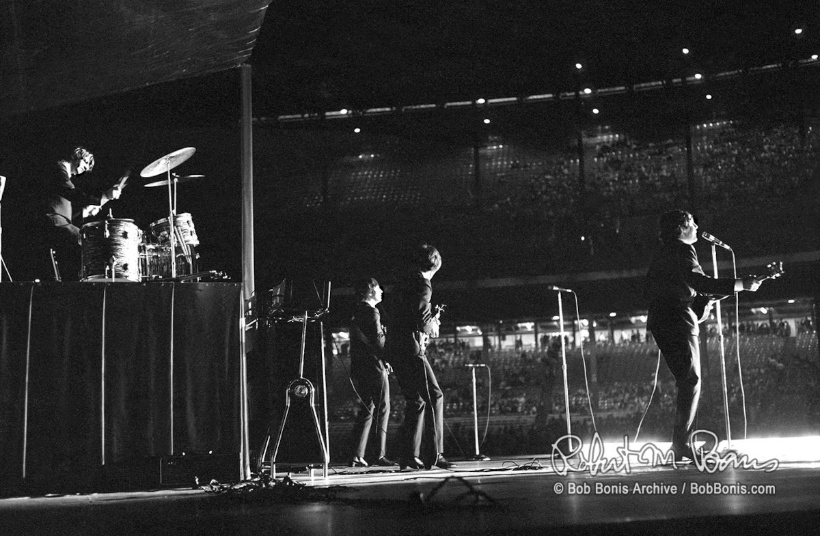
“Kansas City/Hey, Hey, Hey, Hey” by the Beatles. This is the song played after Royals victories at Kauffman Stadium. When they lose, the hit version of “Kansas City” by Wilbert Harrison is played. The Beatles played their version live in 1964 at the prior Kansas City ballpark, Municipal Stadium at 22nd and Brooklyn (courtesy of Charlie Finley).
Bonus Cut. “Let’s Go Crazy” by Prince. This song by the Minneapolis native is often played after home runs by the Twins at Target Field.
Walk-Off Stories – August Stadium Promotions…
Royals: This past Tuesday, Rita and I attended the Royals 8-2 victory with Randy and Beth Nay. The pre-game festivities honored Salvy Perez for breaking George Brett’s career record for home runs by a Royal. Fans received posters celebrating home run #318.
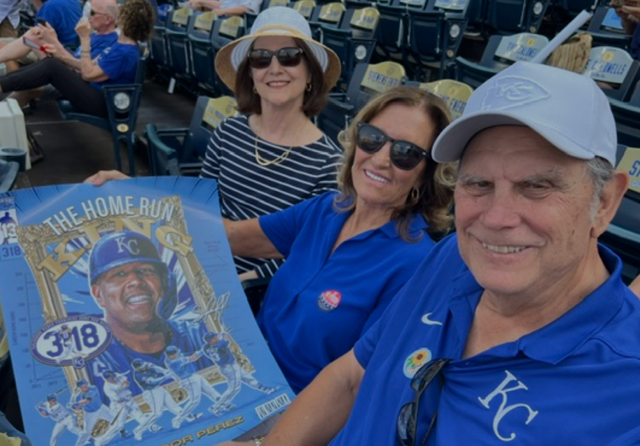
Check out this cool graphic showing the evolution of Royals home run leaders from 1969 to Salvy’s #318.
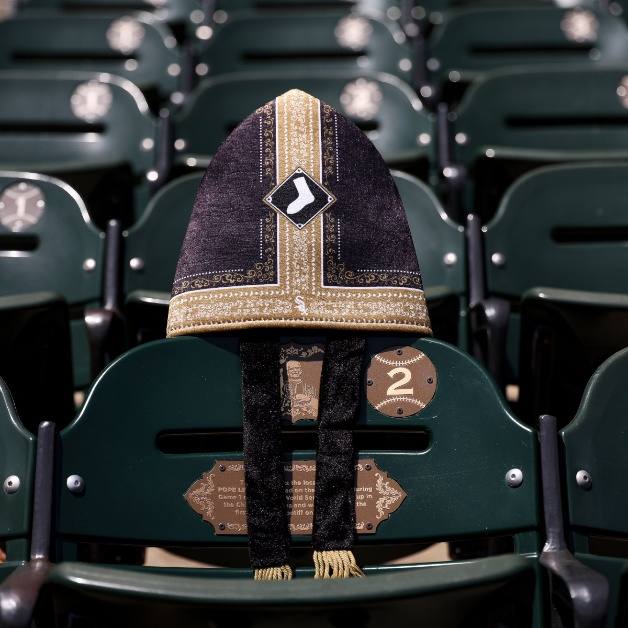
White Sox: On August 11, the Chicago White Sox will honor their most famous fan, Pope Leo XIV, by giving fans a papal-themed miter with an iconic White Sox logo. Wonder if they will someday do a bobblehead.
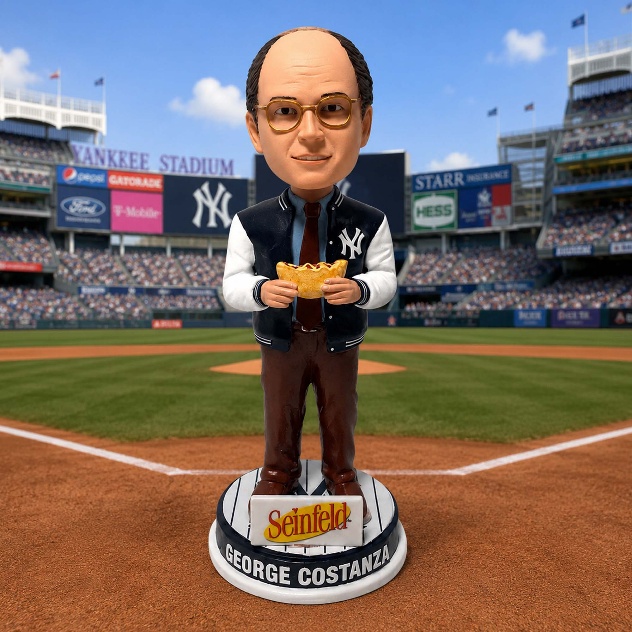
Yankees: On August 27, the Yankees will have another Seinfeld promotion, this time featuring the Costanza/Steinbrenner calzone episode. Seinfeld fans will know what this means. Click here for the relevant clips from the show. Fans at Yankee stadium will receive a Costanza bobblehead.
[Hot Stove Note: I can’t resist Seinfeld trivia. In this week’s Ted Lasso episode, there is funny storeowner who sells Rebecca an outfit. The actress playing the owner is Suzanne Cryer who was George’s girlfriend Marcy in the “Yada Yada” Seinfeld episode. Click here for two minutes of laughter. Thanks to Pete Grathoff of the Kansas City Star for pointing out this piece of trivia.]