Before getting into today’s main topic, I must say this…
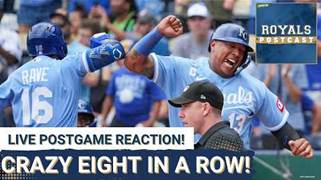
The Royals have won eight in a row!!!
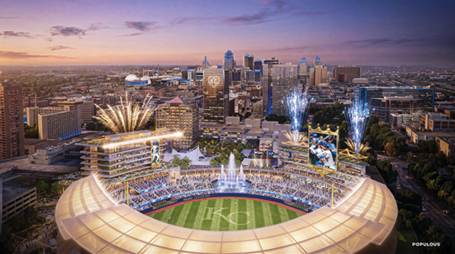
Now down to business. The new Royals stadium at Crown Center is projected to cost $1.9 billion. Last week, Kansas City committed to provide $600 million toward that cost. The state is expected to contribute $514 million. In addition to this public commitment of $1.14 billion (60%), the Royals will add $760 million (40%).
Most of the public discussion to date has emphasized the lack of a public vote and the concern that projected new revenues will not be sufficient to pay off the bonds. These are policy and procedural issues that I’ll leave to the politicians.
There are also rumblings that the team is not paying a fair share. New stadiums today are almost always financed through a public/private partnership. The question is not IF there will be a public share, but HOW MUCH? Under the current Royals proposal, the split is…
60/40 – Public/Private
Is that fair? What is the test? I submit it is the market, and so we need to look at what other MLB cities have done. But first, a little history of MLB in KC.
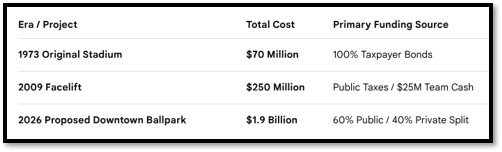
Municipal Stadium: When the A’s moved from Philadelphia to Kansas City in 1955, the city absorbed all the cost of redoing the first level and adding a second level to the stadium. So, the public/private ratio for a stadium for the A’s was…
100/0
Truman Sports Complex: When the expansion Royals moved in 1973 from Municipal Stadium to the Truman Sports Complex, the new Royals Stadium was fully financed by Jackson County. So, the public/private ratio was…
100/0
When the stadium was renovated in 2009, the Royals paid $25 million of the $250 million cost, a ratio of…
90/10
To summarize:
New Chiefs Stadium in Kansas: Although it is football, the Chiefs deal in Kansas is instructive. The total cost is $3 billion for their new domed stadium. Of that, $1.8 billion is public funding and $1.2 billion is to be paid by the Chiefs, a public/private ratio of…
60/40

Other MLB Stadiums: Most of the numbers I use after this come from the website Ballparks of Baseball (click here), which breaks down the public and private cost for construction of all MLB stadiums. I have not confirmed the numbers from other sources, but I believe these will be fine for general comparisons. I’ll start with three popular downtown stadiums.
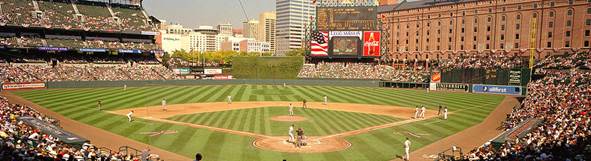
Camden Yards in Baltimore: This gem in the harbor of Baltimore is always toward the top of everyone’s list of favorite stadiums. Public financing came from bonds and notes plus lottery funds. The Orioles contributed very little. The public private ratio was…
96/4
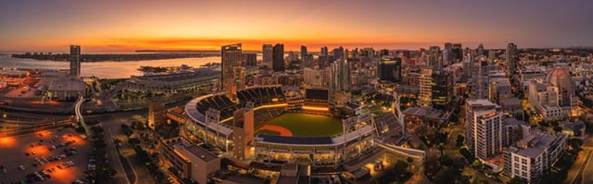
Petco Park in San Diego: A personal favorite of mine, shoehorned into downtown San Diego. Public financing came from the city, county and Port of San Diego. The Padres also provided a significant sum. The ratio is…
57/43
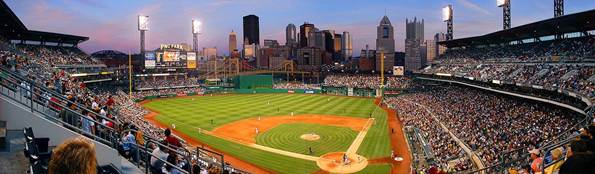
PNC Park in Pittsburgh: The view of downtown through the Roberto Clemente Bridge is spectacular. The city, county and state provided the public share, and the Pirates privately financed the balance. The ratio was…
70/30
Other MLB Parks: I could go on with this format, but I’m thinking readers would prefer I not. So, I’ll use a shortcut for some other MLB stadiums. Target Field in Minneapolis – 64/36. American Family Field in Milwaukee – 66/34. T-Mobile Park in Seattle – 72/28. Chase Field in Phoenix – 71/29. Coors Field in Denver – 75/25. Great American Ball Park in Cincinnati – 82/18. Daiken Park in Houston – 68/32. Rogers Centre in Toronto – 63/37. Progressive Field in Cleveland – 88/12. Rate Field in Chicago (White Sox) – 100/0. LoanDepot Park in Miami – 70/30. Truist Park in Atlanta (actually Cobb County) – 63/37. Nationals Park in Washington D.C. – 100/0.
There are several stadiums with higher team shares, but they are mostly in big markets where teams have lucrative TV income. The Royals are not in that category.
The Royals Deal: Key terms for where the Royals are now and where they will be…
Old: Kauffman Stadium – More than 90% paid with public funds. Ongoing taxes cover maintenance and county pays property insurance.
New: Crown Center Stadium – 60% of stadium cost paid with public funds. Royals cover construction overruns, ongoing stadium maintenance, property insurance and $55 million in community benefits.
Is this fair? Based on the cost history of stadiums in other cities, the 60/40 ratio for the Royals is (pardon the expression) well within the ballpark. Go Royals!
Bonus Valentine: The Royals plan to incorporate the 65-foot heart sculpture built for the World Cup (or a more permanent similar structure) into the stadium area or Washington Square Park.
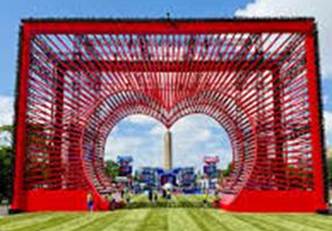
This would be a fitting addition to Crown Center which was developed by Hallmark, the legendary producer of the “very best” Valentine’s Day cards.
Bias Admission: Yes, I am biased. I passionately want a downtown stadium. Even if it does not fully pay for itself. The intangibles of being a major league city are worth it. Certainly, those who lured the A’s, Chiefs and Royals to Kansas City with public-financed stadiums thought so. And I thank the leaders who made it happen (Judges Curry, Petrovic and Wheeler; Mayors Kemp and Bartle; sportswriter Ernie Mehl; businessmen like Les Milgram and Ken Krakauer; etc.)
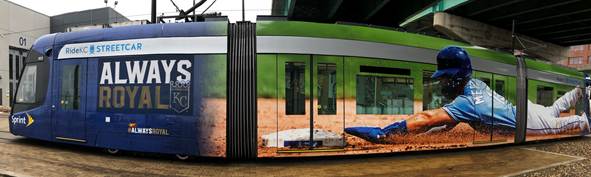
A few days ago, former mayor Sly James wrote an op-ed in the Kansas City Star about the benefit of the streetcar line, a city project that does not directly pay for itself (it’s free to ride). He recalled that critics argued for buses instead, so the line could be moved if needs changed. But Sly argues that this ignores “that permanent steel rails in asphalt offer a level of municipal commitment buses never can.”
As does a downtown stadium.
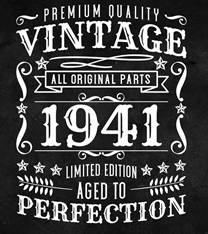
Charles Helzberg is 90: This past Sunday, I sent a “Happy 90th Birthday” email to Charley Helzberg. It included this graphic, and if you know Charley, you will agree he has “aged to perfection.”

About an hour after I sent the birthday email, Rita and I were walking Loose Park and ran into…Charley! Serendipity. We got to wish him happy birthday in person.
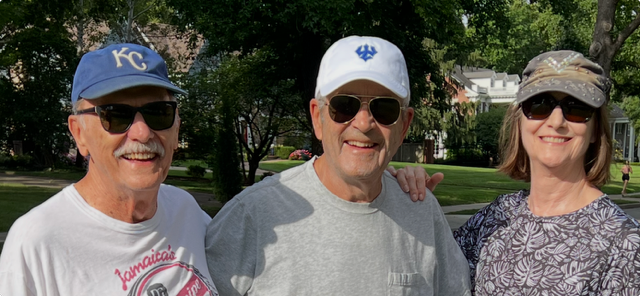
We agreed it was a lovely morning for a walk, and this prompted Charley to take out his phone and share this photo he took at a London subway station.
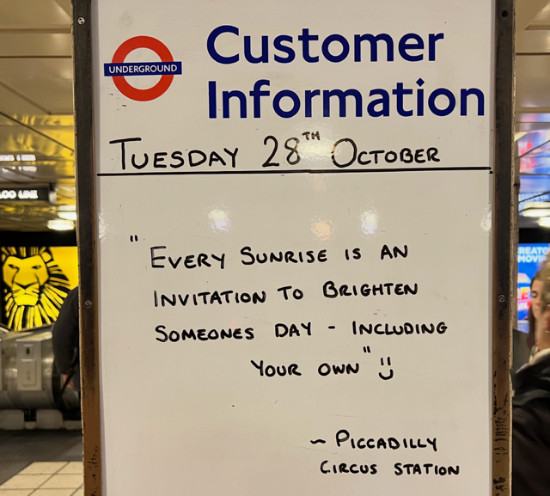
This “every” day sentiment reminds me of a saying by Stan Bushman, Charley’s long time business partner who died last year at the age of 96 (tribute here). Stan’s mantra was “Are you helping others today.”
Rita has a similar mantra, especially for this stage of life. “Every day is extra.” So, please listen to Charley, Stan and Rita. Use every day wisely.
Charley responded to my email, “Impressive graphic design, which I will save for you!” Charley will be 95 when I turn 90. Of course, the birth year will be different, and I spotted this graphic online for 1941. I’m not sure about aged to perfection, but aside from two missing parts (tonsils and gall bladder), I luckily have “all original parts.”
I am accepting Charley’s plan to revisit this in five years, at which time I will join him for a Royals game at Crown Center to celebrate our next milestone birthdays.
Lonnie’s Jukebox – Ted Lasso Edition: Season 4 of Ted Lasso is underway and continues its excellent use of music to help set the mood and tell the stories. In this season’s opening episode, a wonderful love letter to Kansas City, three songs from the setlist directly trace back to the scenes filmed at 18th and Vine.
“Vine Street Boogie” by Jay McShann.
“Oh, Lady Be Good” by Count Basie.
“KC Blues” by Charlie Parker.
The 18th and Vine visit included long scenes at the Negro Leagues Baseball Museum and a lot on Satchel Paige. Below, a screengrab showing character Leslie Higgins entering the museum.
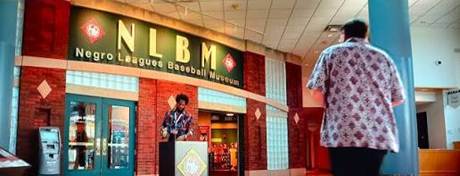
The publicity on the show gave a nice boost in attendance to the museum and in merchandise sales. Per NLBM President Bob Kendrick, “We have just been flooded with folks, local folks who are fans of Lasso.” Google trends indicated searches related to Paige and the museum spiked by more than 5,000% compared to the same period a year ago.
One of the longest-played songs in the episode was “Kansas City” by The New Basement Tapes, a supergroup that released an album in 2014 of songs based on partial, unreleased lyrics by Bob Dylan.
“Kansas City” by The New Basement Tapes. This is not to be confused with the Leiber and Stoller song made famous by Wilbert Harrison. The video with this link is excellent, and you will see Johnny Depp on guitar. He’s sitting in for Elvis Costello who had a conflict that day. The lead singer on the song is Marcus Mumford who also sings on…
“Ted Lasso Theme” by Marcus Mumford and Tom Howe.
Next, from the setlist in Episode 2, as the show switches from Kansas City to Richmond in England…
“Honkey Cat” by Elton John.
“You’re the Inspiration” by Chicago.
“Sisters Are Doin’ It for Themselves” by the Eurythmics (featuring Aretha Franklin). Cool video. The message in this song is clearly that the “sisters” can also play soccer.
And Episode 3…
“Ladies First” by Queen Latifah. For the Lady Greyhounds of Richmond coached by Ted Lasso.
“I Hope I Get It” from A Chorus Line. Team tryouts.
“I Dreamed a Dream” by Susan Boyle in her audition for Britain’s Got Talent. Boyle and her song are part of a running joke throughout Episode 3, which was titled “Richmond’s Got Talent.”
Walk-Off Recommendation – Crystal Bridges: Three hours south of Kansas City in Bentonville, Arkansas, is the Crystal Bridges Museum of American Art. The museum opened in November of 2011 and is funded by Wal-Mart heiress Alice Walton.
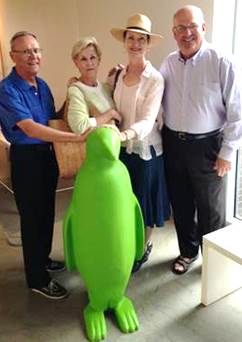
Rita and I first visited in the fall of 2013 with Irv and Sharyn Blond. We stayed at the 21C Museum Hotel, a 15-minute walk by trail to the museum. Below, the four of us with one of the 200 resident penguins at 21C.
Rita and I returned for a second visit in the spring of 2024 when we attended granddaughter Emersyn’s graduation at the University of Arkansas in nearby Fayetteville.
And two weeks ago, we again made the trip, this time to see the 114,0000-square-foot expansion opened this past June. The architect for the original building and the expansion is Moshe Safdie, the architect for KC’s Kauffman Center for the Performing Arts.
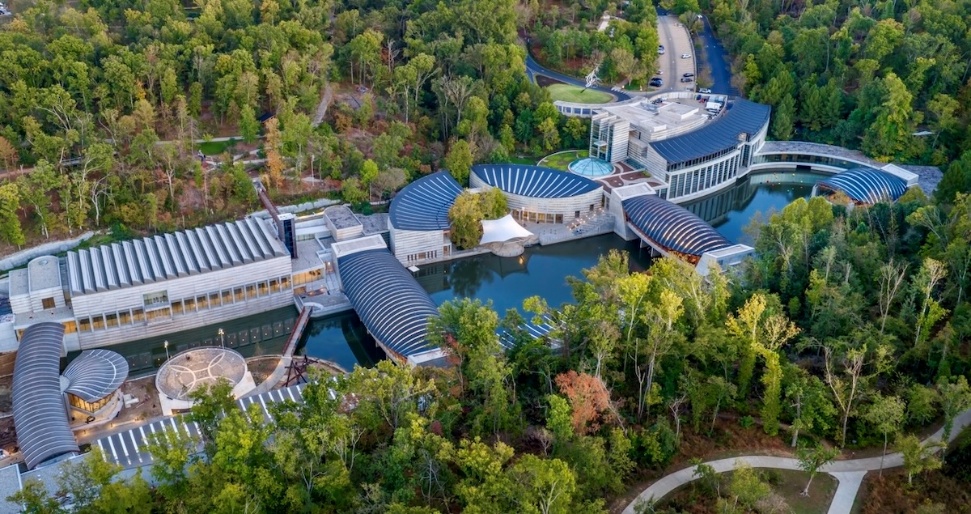
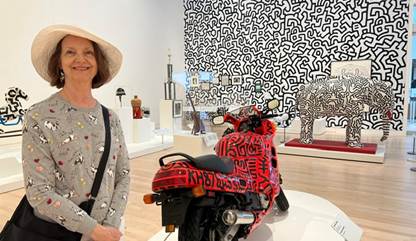
The expansion includes a new contemporary wing and a huge gallery for temporary exhibitions. Below, Rita at the temporary exhibition featuring Keith Haring, a 1980s pop artist first known for New York subway graffiti and then much more. There are hundreds of items in the exhibit, many with his work on everyday items like the motorcycle next to Rita (the name of the exhibit is “Keith Haring in 3D”).
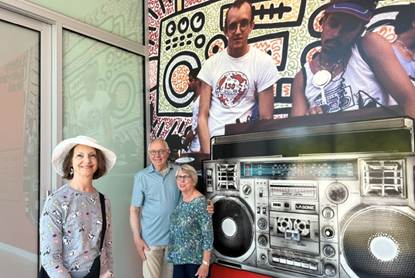
Below, Rita with our fellow travelers, Joe (our driver) and Cheryl Downs in a listening room where you could pop in cassettes to listen to the music that shaped Haring’s world in the 1980s. The boombox was a symbol of public expression, creativity and community. Haring was connected to this culture and believed art should be accessible and move freely, just like the music in the urban environment.
We of course highly recommend the museum. The Haring exhibit ends in January (click here).
There is one more visit to recount. Rita was at Crystal Bridges in 2014 with her St. Teresa’s High School friends Anne Devaney and Lynda McDonnell. When they finished the day at the museum, they headed back on the trail to 21C. A thunderstorm opened up and they were getting drenched. A golf cart came by, and the woman gave them a ride. Rita asked her if she lived around there, and the answer was yes. The woman was Alice Walton, the founder and funder of Crystal Bridges. She graciously posed for a photo.