How to celebrate Hot Stove #300?

I’m going with some major “300” benchmarks in baseball statistics. This might be in the weeds for some readers, but I’ve been following the number 300 in baseball since I was a kid. Specifically, .300 (with a decimal point).
.300 Batting Average: In 1950, the summer I turned 9 years old, I discovered my first baseball hero – Phil “Scooter” Rizzuto who played for the Yankees, the major league affiliate of our Kansas City Blues. He had an MVP season plus two attributes personal to me. He played shortstop (as I did for my cub scout team), and he was short (5’6”), giving hope that I could also someday be a major leaguer (I eventually reached 5’7”, but I was slow and could not hit a curve ball; dreams dashed).
Rizzuto was lauded by his manager Casey Stengel as the “greatest shortstop I’ve ever seen. He can do anything.” He was on the cover of many sports periodicals going into the next season, often showing him bunting the ball. He led the league in sacrifice bunts (19), the only MVP to ever do so. Ty Cobb said Rizzuto was “probably the greatest bunter of all-time.”
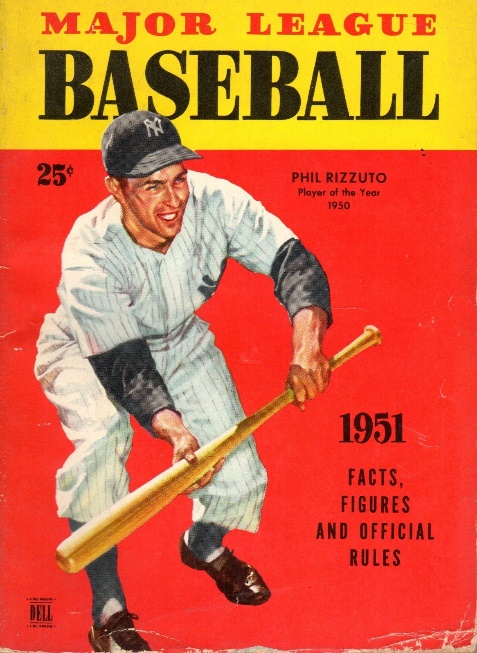
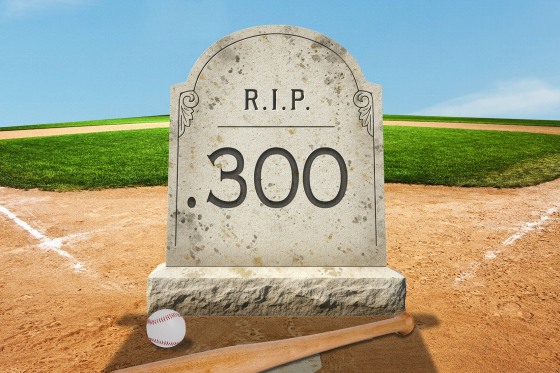
A major benchmark for a good hitter in those days was a .300 batting average, and I got an early long division math lesson by learning how to calculate the stat. George Brett’s hitting guru Charlie Lau said .300 was the “traditionally accepted mark of excellence,” and his 1980 book was titled The Art of Hitting .300. In my favorite baseball movie, Kevin Costner explained the importance of hitting .300 (Bull Durham clip here).
When the 1950 season ended, Boston’s Billy Goodman won the American League batting title with an average of .354. Rizzuto came in sixth at .324, but he easily won the AL MVP award for leading the Yankees to another pennant with his mix of speed, hitting and fielding. Goodman’s high average was rewarded with second place in the MVP vote.
What if those 1950 MVP votes for Rizzuto and Gardner were made using today’s advanced stats? Especially WAR, which is the most influential stat today for MVP and Hall of Fame voting and salary negotiations. Baseball Reference (bWAR) and Fangraphs (fWAR) have gone back in history to convert the stats in earlier years to compute WAR for all players in all seasons. Here are the top five batters by WAR in 1950 in Baseball Reference:
Rizzuto – 6.8
Doby – 6.7
Berra – 6.1
Rosen – 5.8
DiMaggio – 5.2
Where’s Billy Gardner? His WAR was 2.7, far down the list, indicating that batting average alone does not make a superstar in today’s baseball world. Position player WAR involves a combination of several hitting, running and fielding stats, and none of them are as simple to calculate as batting average which I learned to do at age 9. We instead have wRRA, Rbat, Rbaser, Rdp, Rpos, Rrep, etc. Even I do not go into those weeds.
The number of players hitting .300 has trended up and down for decades
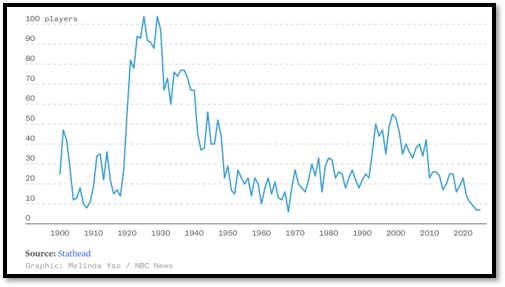
The jump of .300 hitters in 1920 was caused by the transition from the dead ball era to the live ball era. This included (i) banning of “freak” pitches (spitball, scuffed ball, and other doctored balls); (ii) better manufacturing of baseballs to create a harder, more kinetic ball; (iii) requiring umpires to replace scuffed or dirty balls so a clean white ball was always in play; and (iv) popularity of the home run with the emergence of Babe Ruth.
As pitching improved over the years, the number of .300 hitters declined, bottoming out in 1968 with only six major leaguers hitting .300. This prompted MLB to lower the mound and reduce the strike zone. The averages then trended up until 2000 before heading back down again. Why the recent decline?
Pitching is the big factor. Velocity is up. Starters rarely finish, giving way to fireball relievers. Technology on pitch tracking, spin rate, etc. Analytics showing where any hitter will likely hit a ball (the cheat sheets you see fielders referring to as each new batter comes to the plate). So, it’s even hard to get a single, especially three in a row to score a run. Go for the fences for a home run, meaning more home run swings and strikeouts. For more details, see these articles on NBC and NPR.
MLB has recently attempted to help the hitters – reducing fielding shifts and bigger bases. But only seven MLB players hit .300 in 2025. Six, led by AL MVP Aaron Judge (.331), were from the American League. The only National Leaguer to break .300 was Trea Turner (.304, lowest ever for an NL leader). NL MVP Shohei Ohtani hit .284. My boyhood golden statistic has almost vanished.
300 Home Runs/300 Steals: In baseball history, 133 players have hit 300 or more homers and 160 have stolen at least 300 bases. Eight players have done both. The first four are in the photo below: Willie Mays, Bobby Bonds, Andre Dawson and Barry Bonds. The other four: Reggie Sanders, Alex Rodriguez, Steve Finley and Carlos Beltran.
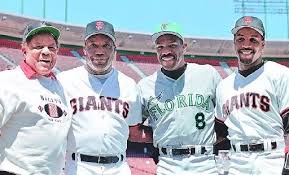
This accomplishment is not an automatic ticket to the Hall of Fame. Only three are in (Willie, Andre and Carlos). Two others are blocked by steroid issues (Barry and Alex).
This is a rare feat because many sluggers are either slow or do not want to risk injury while stealing a base. But fans in 2026 will likely get the privilege of seeing the ninth member enter this exclusive club. Cleveland’s Jose Ramirez has 285 home runs and 287 steals. Last year, he hit 30 homers and stole 44 bases. Go Jose!!
Maybe Jose Altuve (255/325, age 35) and Francisco Lindor (279/216, age 32).
Waiting in the wings – Bobby Witt Jr. of the Royals. It’s early, but at age 25, he already has 105 homers and 148 steals. Go Bobby!!
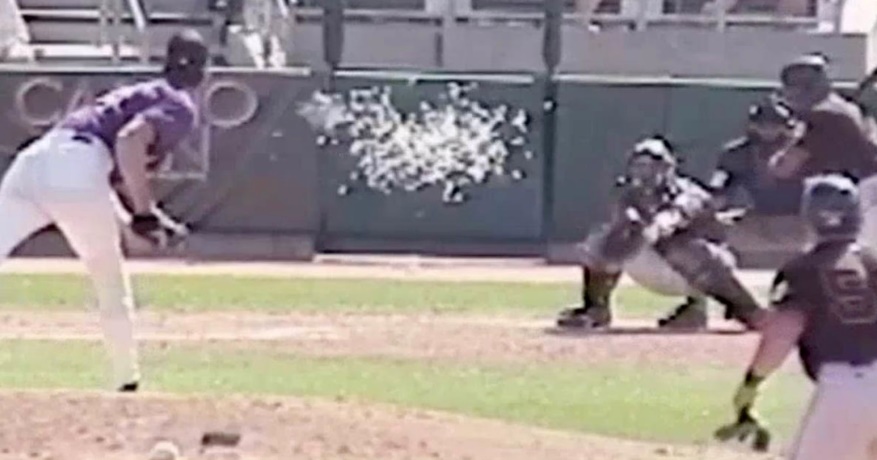
300 Strikeouts in a Season: In the modern era (since 1900), 19 different pitchers have reached the 300-strikeout mark 38 times. Nolan Ryan and Randy Johnson each did it six times. I must pause here to note Randy Johnson’s spring training pitch that defeathered a dove (video here).
The last five pitchers to reach 300: Clayton Kershaw (2015), Chris Sale (2017), Max Scherzer (2018), Gerrit Cole (2019) and Justin Verlander (2019).
And it may never happen again.
Why? Same as one of the reasons discussed above on why batters have difficulty hitting .300. Starting pitchers only go five or six innings before giving way to a series of fireball relievers. This reduces the innings for starters. Complete games are a rarity (29 in 2025; 1,052 in 1975). Last year, the strikeout leader Garrett Crochet (255 Ks) pitched 205 innings.
3000 Strikeouts in a Career: On September 28, 2019, Justin Verlander got his last strikeout of the season. It was very special. It was #300 for the season and #3000 for his career.
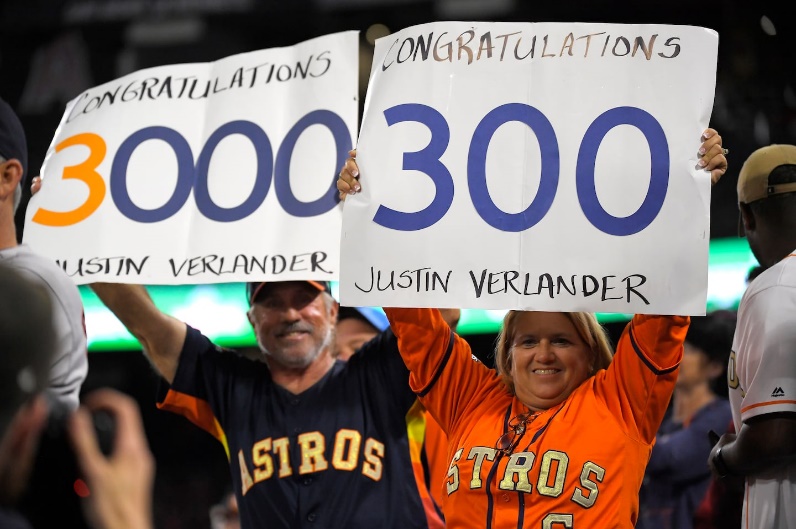
Max Scherzer got #3000 in 2021. And last year, Clayton Kershaw reached #3000.
Kershaw may be the last. Active players with an outside shot are Chris Sale (age 36) with 2579 and Gerrit Cole (age 34) with 2251.
And then, just like the demise of the 300-strikeout season, the 3000-strikeout career will become extinct.
300 Career Wins: One of the traditional measures of excellence for a pitcher has been winning 300 games in his career. Here is Warren Spahn celebrating the feat in 1961 (he eventually won 363).
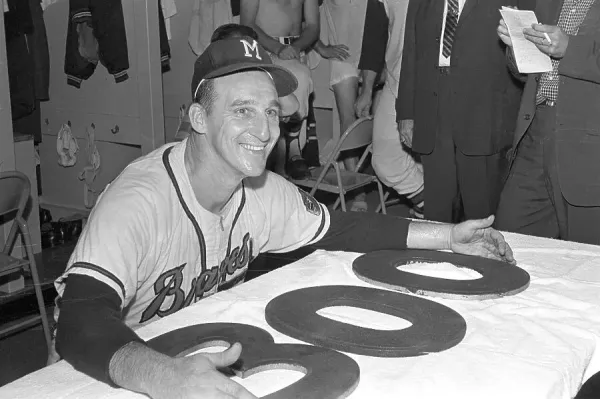
There have been 13 pitchers who began their career in the live ball era (1920 and after) and won at least 300 games. All except Roger Clemens (that steroid thing) are in the Hall of Fame.
Wins are important, right? Not so fast. To explain, let’s return to 1950, but instead of Phil Rizzuto, talk about Ned Garver.
Just as the .300 hitter was golden in 1950, so was any pitcher who won 20 games. Bob Lemon led the American League with 23 wins and easily won the Pitcher of the Year Award from the Sporting News (the Cy Young Award was not established until 1956). Ned Garver, pitching for the 7th place St. Louis Browns was 13-18 for the season, ten wins behind Lemon. Ned’s 1950 baseball card…
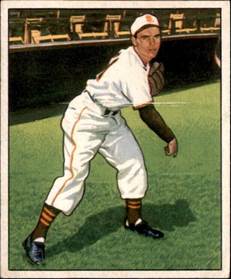
What if we go back and apply today’s WAR numbers to that season? Lemon’s pitching WAR in 1950 per Baseball Reference was 2.7. Ned Garver’s was 7.3! Not a typo. Garver’s pitching was excellent, but his team gave him little support in the field and at bat.
Fast forward to 2025. The Cy Young winner in the American League was Tarik Skubal whose won/loss record was 13-6 (tied for 6th in wins). But he was first in WAR. In the NL, Paul Skenes won the Cy Young even though he was only 10-10, but he was second in WAR and recorded a phenomenal ERA of 1.97.
The difference between 1950 and 2025? WAR ignores wins and focuses on metrics that isolate a pitcher’s performance from factors they cannot control (like lack of run support or bad relief pitchers). A pitcher may throw a gem and lose 1-0. The loss is not a reliable metric for his performance. For pitching WAR, we instead have FIP, RA9, PPFq, RA9opp, K%, etc. Again, I do not go into those weeds.
The last 300-game winner was Randy Johnson who retired with 303 in 2009. The active leader in wins is Justin Verlander (266). He is 42. Next is Max Scherzer (221). He is 40. The rate of wins for the young stars is low.
Conclusion: The exclusive club of 300-game winners will not be gaining any new members.
300 Wins – Kansas City Connections: While checking out the pitchers with 300 wins, I caught some Kansas City connections.
Charles “Kid” Nichols: He was born in Wisconsin in 1869 and moved to Kansas City with his family in 1881. Nichols remained a KC resident for the rest of his life (died in 1953 at age 83). His first minor league ball was played in Kansas City, and in 1890, he began his 15 National League seasons with Boston, St. Louis and Philadelphia. He was quite the pitcher, winning 362 (!) games in his MLB career. He is #82 in Joe Posnanski’s The Baseball 100.
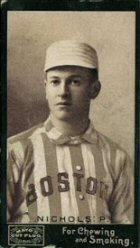
His baseball card for 1895 was issued by the producer of Mayo’s Cut Plug “chewing and smoking” tobacco. Cards were inserted in tins and pouches of the product. Bubble gum came much later.
Nichols was the boyhood idol of his Kansas City neighbor Charles “Dutch” Stengel. In Marty Appel’s biography of Stengel, he tells of Nichols giving advice to the young Stengel:
“I understand you get in a lot of trouble at school and in a lot of arguments. Now when you start out in baseball, the best thing you can do is listen to your manager. And once in a while you’ll have an old player teach you. Always listen to the man. Never say, ‘I won’t do that.’ Always listen to him. If you’re not going to do it, don’t tell him so. Let it go in one ear, then let it roll around there for a month, and if it isn’t any good, let it go out the other ear. If it is any good after a month, memorize it and keep it. Now be sure you do that and you’ll keep out of a lot of trouble.”
Stengel, later to be known as Casey for his KC hometown, must have listened. He was successful as both an MLB player (14 seasons) and manager (seven World Series Championships).
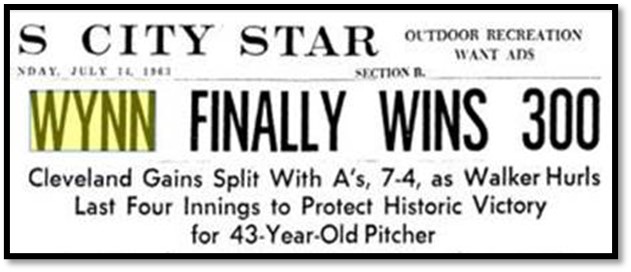
Early Wynn: This Cleveland hurler won his 300th game on July 13, 1963, beating the A’s at Municipal Stadium in Kansas City. Hot Stove subscriber Clay Coburn, then nine years old, was in attendance.
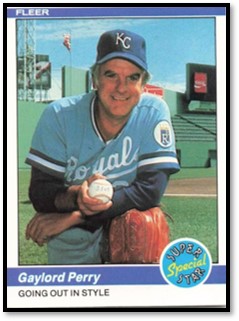
Gaylord Perry: In his 22nd MLB season, Gaylord Perry signed as a free agent with the Kansas City Royals on July 3, 1983. It would be his final season. He won four games for the Royals to bring his career total to 314. He was inducted into the Hall of Fame in 1991 and is #68 in Joe Posnanski’s The Baseball 100.
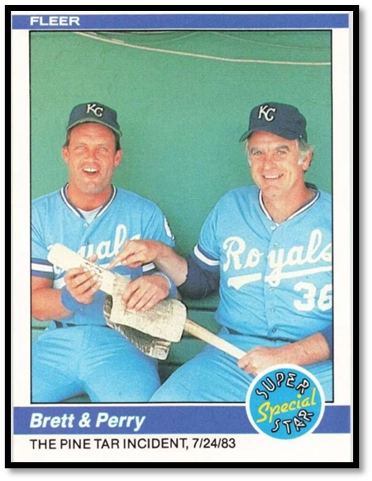
But that’s not why I remember him from 1983. On July 24, George Brett was famously called out after hitting a home run with a bat covered with too much pine tar. While everyone focused on the argument at home plate, Perry grabbed the bat and started a relay to get it to the clubhouse to hide the “evidence.” As a famed thrower of spitballs, Perry was familiar with illegal substances on the equipment. The alert umpires and stadium security retrieved the bat. The incident netted Perry an additional baseball card for his last season.
Phil Rizzuto Trivia: Returning to my boyhood baseball idol…
In 1949, this well-known photo was taken of Rizzuto with Frank Sinatra in the Yankees dugout.
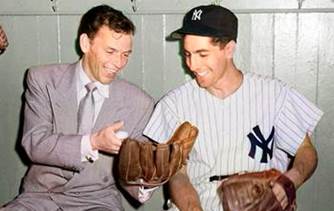
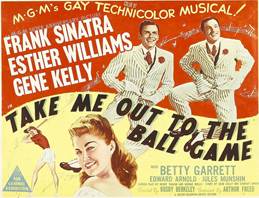
Sinatra was promoting his role in the baseball-themed film musical Take Me Out to the Ball Game (trailer here; streaming on Prime, Apple and YouTube for $4).
In 1955, my MLB fandom abruptly switched from the Yankees to the A’s who had relocated from Philadelphia to Kansas City. But now I got a chance to see Rizzuto play in person. My 8th grade pal Jay DeSimone and I took in many games that first KC major league summer, several with the Yankees. We scored some autographs on our scorecards, including this one of my man Phil (slightly faded after 70 years).

In 1977, Meat Loaf released “Paradise by the Dashboard Light,” a song about a young couple (“barely 17 and barely dressed”) in a car. The dashboard light is from the radio that is tuned to a baseball game narrated by Yankee announcer Phil Rizzuto. As Rizzuto is heard doing his play-by-play of a runner getting to second base, then third base and maybe scoring, Meat Loaf’s song tells a parallel story about the couple in the car. Without doubt, one of the finest examples of baseball metaphors. See Meat Loaf’s fantastic live performance here.
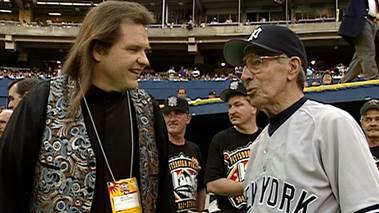
When Rizzuto got some flak from fans for taking part in the risqué song, he claimed he did not know it was going to be used that way. He apparently forgave Meat Loaf. Here they are together in 1994 when Meat Loaf sang the National Anthem at the All-Star Game. Rizzuto was serving as captain for the American League, an honor bestowed because of his election that year to the Hall of Fame.
Lonnie’s Jukebox – Neil Sedaka Edition: Neil Sedaka died last month at the age of 86. His songs from the first phase of his career were part of the soundtrack for my college years.
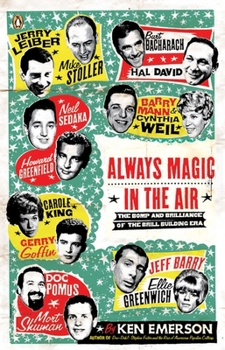
Sedaka grew up in Brooklyn in the same neighborhood as Carole King and Neil Diamond. He was a child prodigy on the piano, earning a place in a Julliard program for children. When he was 13, he met 16-year-old Howard Greenfield, an aspiring poet and lyricist. Sedaka and Greenfield became one of many songwriting duos who churned out pop hits in the late 1950s and into the 1960s at the Brill Building and nearby offices in New York. A good history of that time is in Ken Emorson’s Always Magic in the Air: The Bomp and Brilliance of the Brill Building Era. The duos shown on the cover are part of songwriting royalty.
A great way to get a feel for the “always magic in the air” atmosphere at the Brill Building is to see the Broadway show Beautiful: The Carole King Musical. Rita and I have seen it twice, and it’s, well, beautiful.
Sedaka composed the music and Greenfield wrote the lyrics for hundreds of songs to be sung by Sedaka and others. One of their first hits was by Connie Francis.
“Stupid Cupid” by Connie Francis (1958). Sedaka and Greenfield pitched several songs to Francis who was looking for a follow-up to her hit “Who’s Sorry Now.” They presented some, but she and her friend Bobby Darin thought them too slow and dense for the current pop market. Asked if they had something bouncier, the songwriters offered this song, and Francis had her next hit. The close relationship of Francis and Darin is a big part of the current Broadway hit Just in Time.
“Oh! Carol” by Neil Sedaka (1959). Sedaka’s first top 10 hit. He had briefly dated Carol Klein in high school and so decided to use her name for this song. While still in high school, Carol took the stage name of Carole King when forming her first band and making demos with Paul Simon. She married Gerry Goffin, and the two found work at the Brill Building with the same firm Sedaka was working.
“On! Neil” by Carole King (1959). The first King/Goffin song, a jocular answer song to Neil’s “Oh! Carol.” It did not chart.
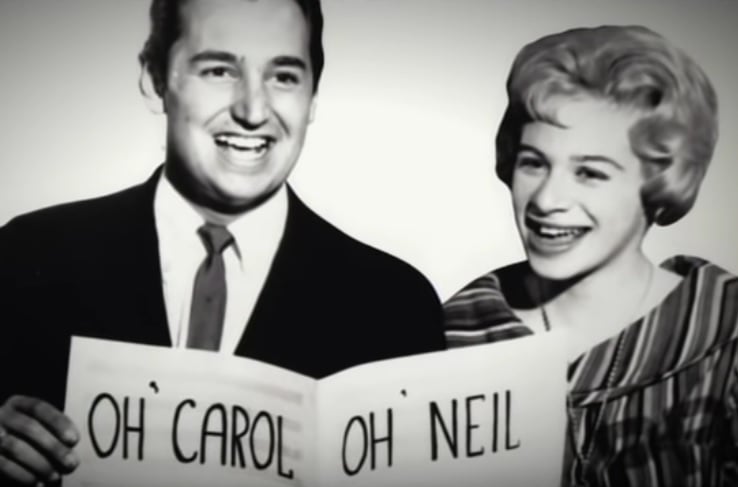
“Calendar Girl” by Neil Sedaka (1960). First top 5 hit.
“Where the Boys Are” by Connie Francis (1961). Another Sedaka/Greenfield composition for Connie Francis. In addition to being the title song for the 1960 movie, Connie’s record went to #4.
“Happy Birthday, Sweet Sixteen” by Neil Sedaka (1961).
“Breaking Up Is Hard to Do” by Neil Sedaka (1962). A #1 hit.
Neil has some moderate chart success in 1963, but he then fell off the charts for ten years. The reason: The British Invasion. Music taste changed, and at age 24, he was old school. With no new hits, he and Howard Greenfield reluctantly agreed to split in 1973. The A-side of their 1973 record said it all…
“Our Last Song Together” by Neil Sedaka (1973). As for the B-side, it will come up below.
In the mid-1970s, Neil found a new writing partner, Phil Cody. RCA had dropped Neil, and Elton John said he would help Neil with a comeback. Neil signed with John’s Rocket Records, and Sedaka was back! And his first album at Rocket said so.
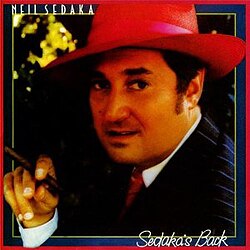
Sedaka had great success with Rocket Records in the mid-1970s and was also able to recycle a couple of tunes from his Greenfield days.
“Laughter in the Rain” by Neil Sedaka (1974). The first big hit of the Phil Cody collaboration. A monster hit that went to #1.
“Breaking Up is Hard to Do” (1975). Neil reinterpreted his upbeat 1962 song as a ballad, and it went to #8.
“Solitaire” by the Carpenters (1975). This Sedaka/Cody song was covered hauntingly by the Carpenters for a #17 hit. Clay Aiken covered it in 2004 and took his single to #4 after singing it on American Idol.
“The Immigrant” by Neil Sedaka (1975). In honor of immigrants in general and specifically John Lennon for his immigration issues. “There was a time when strangers were welcome here…It was a sweeter tune and there was so much room that people could come from everywhere.”
“Love Will Keep Us Together” by Captain & Tennille (1975). Remember “Our Last Song Together” from above. The B-side of that Sedaka/Greenfield record was “Love Will Keep Us Together.” In 1975, Captain & Tennille recorded a cover, and it was the #1 song of the year.
“Bad Blood” by Neil Sedaka (1975). The second Sedaka/Cody song to hit #1 for Rocket Records. Elton John on backing vocals. Below, Elton and Neil in the recording studio.
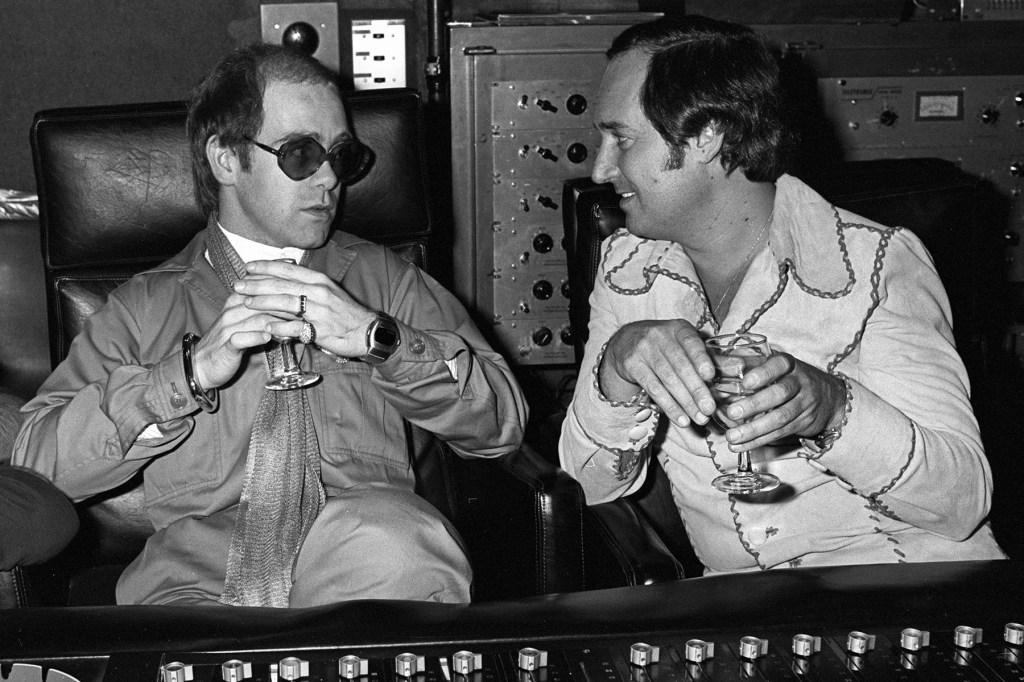
“Steppin’ Out” by Neil Sedaka (1976). Neil’s last top 40 hit. Again, Elton John on backing vocals.
Sedaka’s songs then faded from the charts, but he continued to write, record and perform for years. In 1978, I was in Las Vegas advancing for Vice President Walter Mondale, and Neil Sedaka was performing in a casino lounge. I went to the late show and was transported back to my college days when he sang his songs from the 1960s. When he moved to the 1970s, I got to hear my favorite Sedaka song, “Laughter in the Rain.”
RIP Neil.