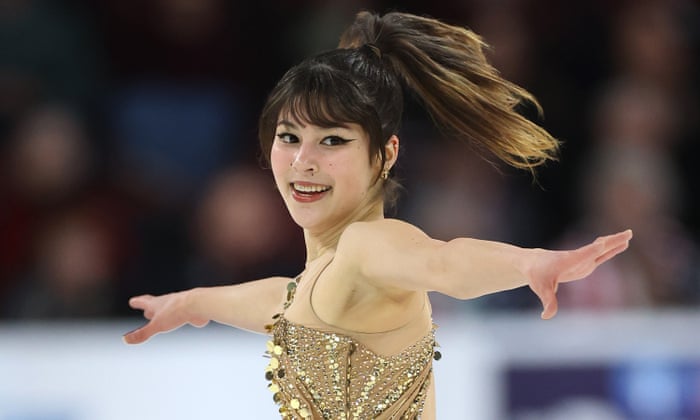
First, a nod to the Winter Olympics. And a big shoutout to figure skater and “baseball pitcher” Alysa Liu who thrilled us with a gold medal performance to the disco beat of Donna Summer (more on this later in Lonnie’s Jukebox). 
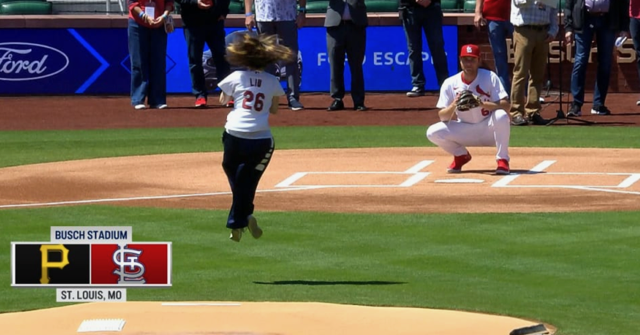
Baseball pitcher? Below, Liu performing a double axel as part of her “windup” to throw out the first pitch at a Cardinals game at Busch Stadium. Check out the video here.
Liu’s appearance at Busch was in May of 2025, and she was wearing #26 to promote the 2026 U.S. Nationals scheduled for January in St. Louis. It now also applies to her 2026 Olympic victory.
In other baseball news…
Something Old – The Minneapolis Millers: The constant flow of recent news out of Minneapolis prompted me to think back to my first notice of the city. It was about 75 years ago when I was a baseball-crazed kid and a fan of the Kansas City Blues, a minor league team playing in the American Association. I followed the Blues in the Kansas City Star (and morning Times in those days) and listened to Larry Ray’s play-by-play on the radio.
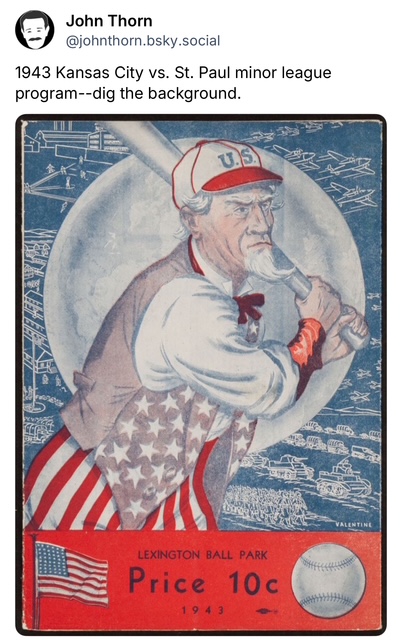
The other seven teams in the league: Minneapolis Millers, St. Paul Saints, Columbus Red Birds, Louisville Colonels, Milwaukee Brewers, Indianapolis Indians and Toledo Mudhens. Below, a recent post by John Thorn, MLB’s official historian, of a wartime-themed program for a 1943 game between Kansas City and St. Paul.
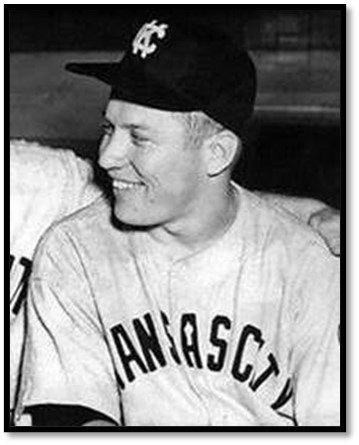
When the baseball season started in 1951, I was nine years old. Although I did not appreciate it at the time, my radio listening and newspaper reading would have included coverage of two all-time greats, Mickey Mantle for Kansas City (a farm team of the Yankees) and Willie Mays for Minneapolis (a farm team of the Giants).
Mantle started the 1951 season with the Yankees but was sent down to Kansas City in July after a poor start. He played 40 games for the Blues and then headed back to New York for good.
Mays started the 1951 season with Minneapolis and got off to an amazing start. When the Millers came to Kansas City for three games on May 21, 22 and 23, Joe McGuff of the Star took note:
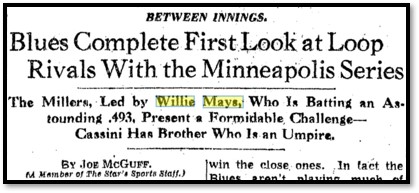
And in his “Sporting Comment” column, Sports Editor Ernie Mehl said, “…there’s this Willie Mays, Minneapolis center fielder who currently is carrying on a solo raid against all pitchers he has faced.”
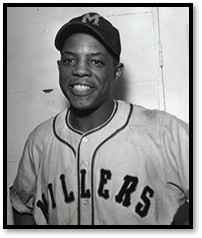
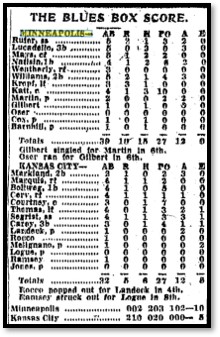
In the first game in KC, Mays got a couple of hits (box score below), but the Blues pitchers held Willie back slightly in the series (his average dropped from .493 to .477). The Millers won two of the three games.
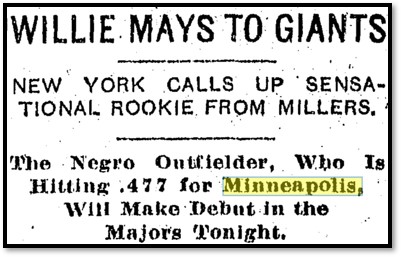
Counting the three games in Kansas City, Willie had played in 35 games for Minneapolis. There would be no more. The phenom was called up to the Giants to begin his major league career. As headlined in the Kansas City Star…
Minneapolis fans were devastated, especially those who had not yet seen Mays in person. Giants President Horace Stoneham placed a quarter-page ad in the Minneapolis Tribune, sort of an apology for taking Mays away so soon, but pointing out, “We appreciate his worth to the Millers, but…merit must be recognized.”
The Blues last season in Kansas City was 1954. The town went major league with the relocation of the Philadelphia A’s in 1955. The Millers and Saints ended their stays in Minneapolis and St. Paul in 1960 to make way for the Washington Senators to relocate in 1961 and become the Minnesota Twins.
Something New – Automated Ball-Strike (ABS) Challenge System: Over the years, the strike zone has changed several times.
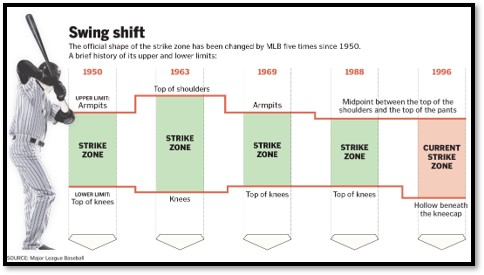
The rule adopted in 1996 for the upper and lower part of the zone remains in place: Upper: The midpoint between the top of the shoulders and the top of the pants; and Lower: The hollow beneath the kneecap.
For the upcoming season of 2026, the umpires will still be using this rule but be subject to challenge on their calls under the Automated Ball-Strike (ABS) Challenge System. The pitcher, catcher and batter (but no one else) can challenge a call by immediately tapping his cap after the pitch. A graphic of the pitch will be immediately displayed on the scoreboard and TV screen to show if the call was correct. Each team is limited to two failed challenges per game (additional challenges are available for extra innings).
The strike zone under ABS has some differences from the rule followed by the umpires.
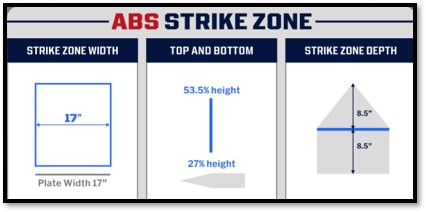
Additional detail is in this chart I got with Google AI (and checked for accuracy):
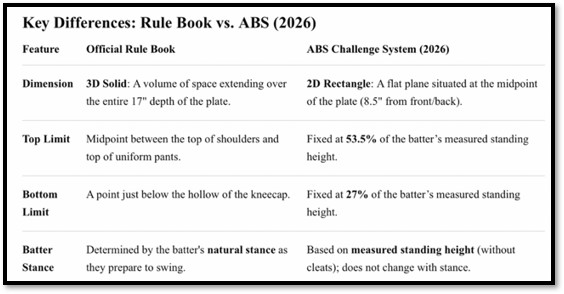
The ABS technology was tweaked in various ways as the system was tested in the minor leagues. The players and officials seem satisfied and now will be directing their attention to the strategy on when to use ABS (early in the game, certain counts, catcher better than pitcher, etc.). It will be interesting to watch as this unfolds.
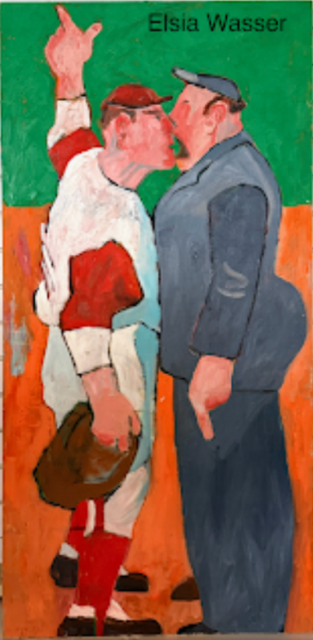
What will be almost gone? Arguing with the umpire. Instant replay ended a lot of this, and now the calling of balls and strikes will be subject to challenge. Although players, managers and coaches are not supposed to argue balls and strikes, they often did and got thrown out of games. And fans watching on TV would also be screaming when the ball was not in the box and was called a strike (that box may be gone now).
So, we will lose some classic baseball finger pointing. The painting below is by a local artist, the late Elisa Wasser (thanks to Tracy Thomas for sending). And the photo is umpire Steve Palermo arguing with Baltimore manager Earl Weaver who was tossed from 96 games in his career.
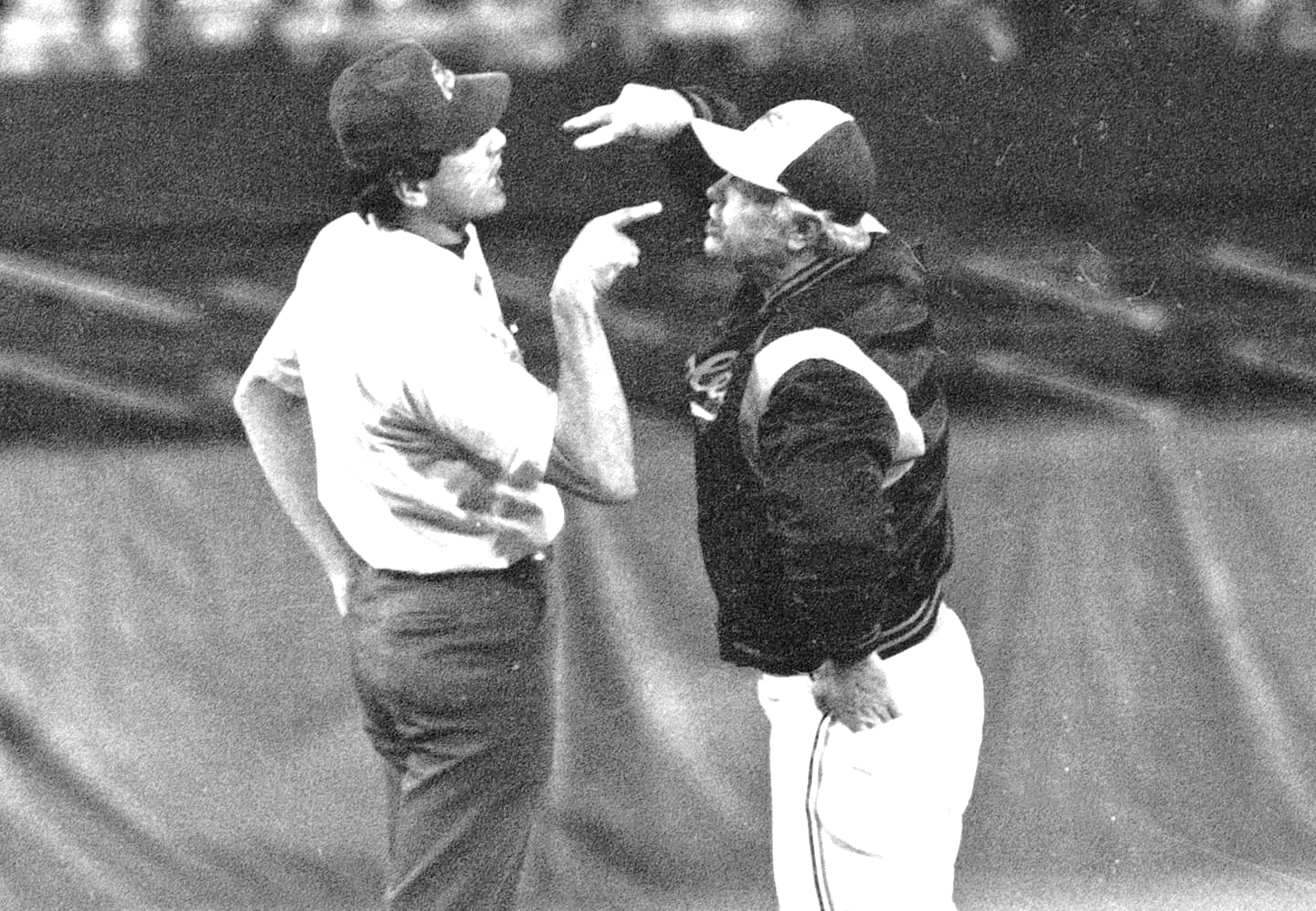
Palermo was an MLB umpire from 1977 to 1991. George Brett said, “I remember when he came up…it didn’t take him long to be respected as one of the finest umpires in the game…probably the best umpire in baseball.” In 1991, after umpiring a Rangers game in Dallas, Palermo was eating in a restaurant when he heard two women were being mugged in the parking lot. He went to their assistance and was shot, leaving him paralyzed. He was living in Kansas City at the time (his wife Debbie is a KC girl) and rehabbed here through an inspiring battle to walk again. He stayed involved in baseball, including serving as supervisor of MLB umpires. He died in 2017 at age 67.
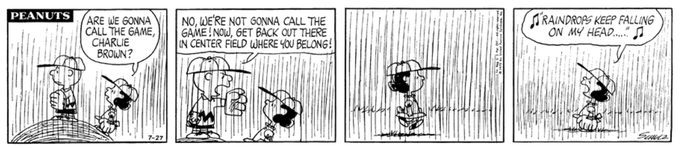
Something Borrowed – Postponed Because of Rain: This Hot Stove is long enough. So, I’ll just borrow from Charles Schulz for this one.
Something Blue – Keeping Up with the Royals: Warning…
WEED ALERT!!!! This is one of those sections where Rita thinks I’m in the weeds. And I agree. This section is for the hard-core readers who want to read even more. So, feel free to skip to the good music in Lonnie’s Jukebox.
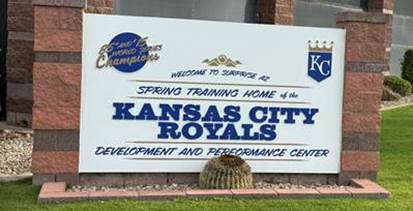
Spring training is underway. To keep up with the Royals during spring training (and during the season), here are some sources. I’m also including sample articles to give you a flavor. You may run into some paywalls. And no, I do not have time to read all these sites all the time. Triage is inevitable.
Kansas City Star – Royals Link: The Royals beat reporter is Jaylon Thompson, and additional coverage comes from columnists Vahe Gregorian, Sam McDowell, Blair Kerkhoff and Pete Grathoff. Sample: “Joe Caglione is known for elite power. Now, he must expand his overall game.”
Royals Review: Part of the SB Nation Network. Includes daily “Royals Rumblings,” a roundup of Royals news from multiple sites. Sample: “Will the Royals use a six man rotation.” Bradford Lee delivers some great nostalgia on this site, like “Baseball Milestones Achieved in Kansas City.”
MLB Beat Reporter Anne Rogers. Click on the link to sign up for MLB’s beat reporter for the Royals. Sample: “Royals lifer John Wathan elected to club’s Hall of Fame.”
Into the Fountains: Sample: “What I want to see in Surprise.”
Royals Keep: Sample: “Who will lead off for the Royals.”

Kings of Kauffman: Sample: “Royals Vinnie Pasquintino’s leadership.”
Joe Blogs: Joe Posnanski appreciated his time in Kansas City, and he often writes about our teams. Sample: “Floors, Fences, and Flyballs,” on moving the fences in at Kauffman Stadium.

The Athletic Windup: Although the full version of the Athletic requires a paid subscription, some newsletters are free. The baseball newsletter from Ken Rosenthal and Levi Weaver arrives five days a week (signup page is here). Former KC Star sportswriter Andy McCullough is now at the Athletic, and his poignant post on the tragic death of Terance Gore included this wonderful line: “He crackled with life, first as a kid brother of those Royals teams, and later as a journeyman bouncing from contender to contender in search of a base to steal.”
Apple News: I am putting this on the list even though I know it will draw sighs from some friends who think I must get a commission from Apple for my sales pitch. I defend myself by saying the $12.99/month cost gets me the Wall Street Journal, New Yorker, Atlantic, Rolling Stone, Sports Illustrated (yes, including the swimsuit issue), the Athletic, Golf Digest, Tennis, World Soccer, Vanity Fair, Politico and other political blogs, USA Today, Time, and on and on – 500 plus magazines, blogs and newspapers (e.g., the LA Times and KC Star). One condition: Need an Apple device for the app.

When you subscribe, you set up your regular reads to easily go to each one. In your “My Sports” section, put in your favorite teams to customize your feed, and a click will get you articles about those teams from multiple sources. And get this – you can add five family members for free. End of pitch.
Lonnie’s Jukebox (1) – Alysa Liu Gold Medal Edition: For her gold medal in free skate, Alysa Liu joyously skated and danced to Donna Summer’s “MacArthur Park Suite.” Liu had never heard of Summer’s song (it was released decades before Liu was born), but her coach and choreographer thought it would be good for Liu’s routine. After listening to the song, Liu agreed. Now, so do millions of others.
Here is some history on how the song went from the pen of Jimmy Webb in 1967 to the Olympics in 2026.
“MacArthur Park” by Richard Harris (1968). Singer/songwriter Jimmy Webb wrote the song in 1967 and offered it to the Association to record. They turned it down, but Richard Harris liked it, and his recording was released in 1968. The record was unusually long (7:21) for a single, but it was a big seller and peaked at #2.
“MacArthur Park” by Waylon Jennings with the Kimberlys (1969). This version went to #26 on the country chart and won a Grammy for Best Country Performance by a Duo or Group.
“MacArthur Park” by Donna Summer (1978). The song moved from pop and country to disco with Donna Summer. Her album version of the song was over eight minutes, but it was cut to four minutes for this single. It became Summer’s first #1 hit.
![Donna Summer – MacArthur Park Suite / Last Dance – Vinyl (12", 33 ⅓ RPM + 2 more), 1994 [r916245] | Discogs](https://lonniesjukebox.com/wp-content/uploads/2026/03/donna-summer-macarthur-park-suite-last-dance.jpeg)
“MacArthur Park Suite” by Donna Summer and Alysa Liu (2026). Summer also released in 1978 a 17.5-minute medley of MacArthur Park and other songs that was a big dance club hit. It was an excerpt from this recording that Liu skated to for the gold medal. Jimmy Webb, now 79, was of course pleased, saying…
“Alysa Liu’s energy and youth breathes yet another life into my song, ‘MacArthur Park.’ I am unbelievably proud to play some small role in the inspiration. I am so impressed with her demeanor; she makes America proud again. Congratulations on your gold medal, Alysa!”
Lonnie’s Jukebox (2) – Two Broadway Musicals: In response to Lonnie’s Jukebox in Hot Stove #298, retired sportswriter George Vecsey cheered the inclusion of “Joy to the World” by Three Dog Night. It reminded him of listening to his car radio in the early 1970s when he took a break from sportswriting to cover Appalachia for the New York Times. George reminisced about some other favorite songs from the era, including Yvonne Elliman’s “I Don’t Know How to Love Him” from the Broadway musical Jesus Christ Superstar. This reminded me that Three Dog Night’s “Easy to Be Hard” also came from a Broadway musical – Hair.
Two great Broadway shows. Hair opened on Broadway in 1968 and Jesus Christ Superstar in 1971. Several songs from the musicals were covered by various artists and became hit singles.
From Hair:
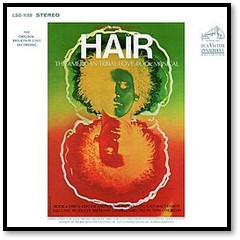
“Aquarius/Let the Sunshine In” by the Fifth Dimension (a #1 hit). This 1969 medley of two songs from Hair won the Grammy for Record of the Year. The group also won Record of the Year for their 1967 hit “Up, Up and Away” (written by Jimmy Webb).
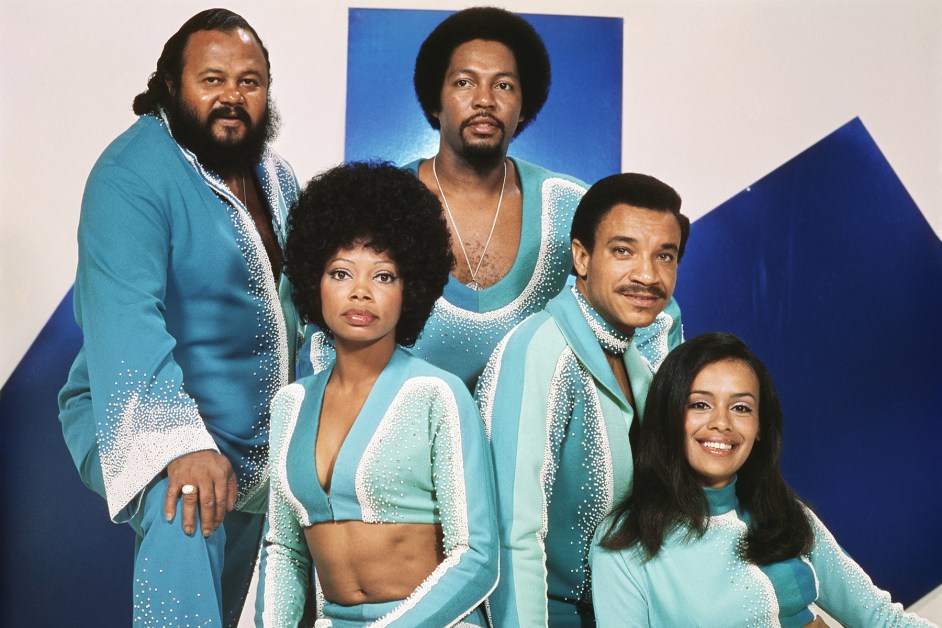
Left to right: Ron Townson, Florence LaRue, Billy Davis Jr., Lamonte McLemore and Marilyn McCoo. Earlier this month, McLemore died at the age of 90. Townson is also deceased. Davis (87) and McCoo (82) have been married over 50 years and are still performing.
“Hair” by the Cowsills (peaked at #2).
“Good Morning Starshine” by Oliver (#3).
“Easy to Be Hard” by Three Dog Night (#4).
From Jesus Christ Superstar:
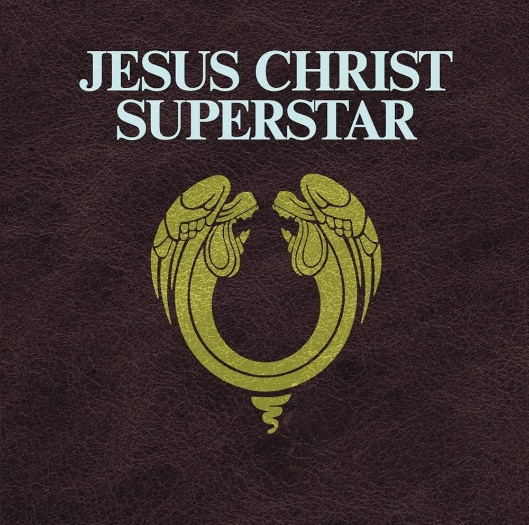
“Superstar” by Murray Head with the Trinidad Singers (#14). This single was issued before the full album and featured Murray Head singing as Judas. In the Broadway show, Ben Vereen played Judas, and in the 1973 movie, it was Carl Anderson.
“I Don’t Know How to Love Him” by Yvonne Elliman (#28). Yvonne Elliman played Mary Magdalene in the Broadway show and the movie.
![Yvonne Elliman - I Don't Know How to Love Him (Jesus Christ Superstar, 1973) [Restored]](https://lonniesjukebox.com/wp-content/uploads/2026/03/yvonne-elliman-i-dont-know-how-to-love-him-jes.jpeg)