We are all familiar with the Hallmark slogan, “When you care enough to send the very best.”
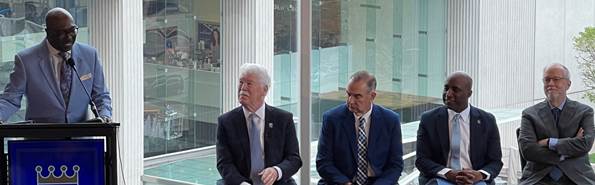
Last Wednesday, Hallmark and the Royals delivered on that message. The new downtown stadium for the Royals will be in Crown Center. Below, Bob Kendrick, president of the Negro Leagues Baseball Museum, introducing the speakers at the announcement: Royals owner John Sherman, Missouri governor Mike Kehoe, Kansas City mayor Quinton Lucas, and Hallmark board chair Don Hall Jr.
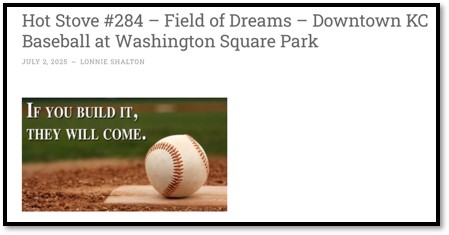
The specific location was a big surprise. Most of the talk on a proposed downtown stadium had been on Washington Square Park. And Hot Stove was all in. From July of 2025…
With the proximity of Crown Center, the Royals and Hallmark were destined to cooperate on the overall development. The new angle not anticipated by most of us was that Hallmark was primed to move from their aging and underused multi-building campus to a modern headquarters within Crown Center. This left open a perfect space to embrace a new baseball stadium. It was not a bait-and-switch. It was good karma.
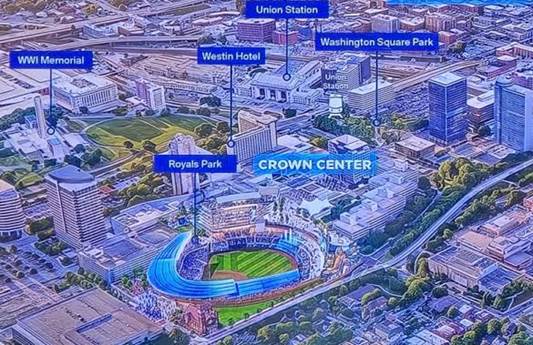
It’s a win-win-win (and more, but here are the big ones):
1. Hallmark’s headquarters remain at Crown Center, but in newer facilities.
2. The Royals and the citizens of Kansas City get a downtown stadium.
3. Washington Square Park becomes a ballpark district with residential, office and entertainment uses that will generate taxes to help pay off the stadium bonds.
I was part of the audience at the announcement and was excited by the presentations from John Sherman for the Royals and Don Hall Jr. for Hallmark. These are two of most civic minded and philanthropic citizens of Kansas City, following in the footsteps of Ewing Kauffman and earlier generations of the Hall family.
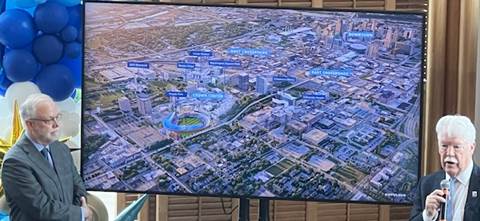
Hall and Sherman shared stories of the history of Kansas City, from Joyce C. Hall arriving in 1910 to former mayor Kay Barnes goal of a “Downtown” that includes “River-Crown-Plaza,” connecting the core of the city. Hall spoke of his grandfather J.C. Hall building his company here because he believed in the spirit of Kansas City. Sherman quoted Harry Truman, “Make no little plans.”
Below, some history of earlier “big” plans that led to this moment.
The 1910s – J.C. Hall and Union Station: In 1910, Joyce C. Hall arrived by train in Kansas City. This would have been at the Union Depot in the West Bottoms. Hall was impressed with the spirit of Kansas City and stayed on to create and grow an iconic company.
In 1914, needing more room and to escape periodic flooding, the railroads moved their operations to Union Station at the intersection of Main and Pershing Road. Below, the grand opening on October 30, 1914.
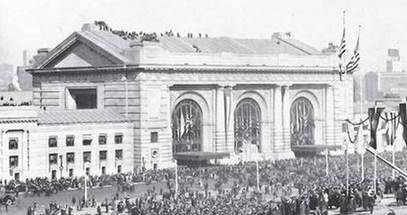
One of the landowners displaced by the new station was Our Lady of Sorrows Church.
The 1920s – A Century Ago: A busy decade in Kansas City history. In addition to jazz and speakeasies…
1922: Harry Truman, backed by the Pendergast machine, won his first election to become the administrative judge representing Jackson County’s eastern district.
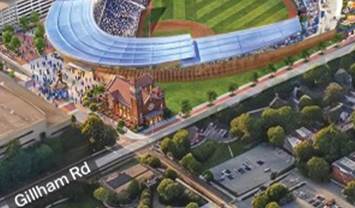
1923: When Our Lady of Sorrows Church moved to make way for Union Station, the parish built a new school and church at 26th and Gillham. A bigger church was built on the site in 1923 and has continued to serve its parishioners for 103 years. The church will be on the home plate side of the new stadium.
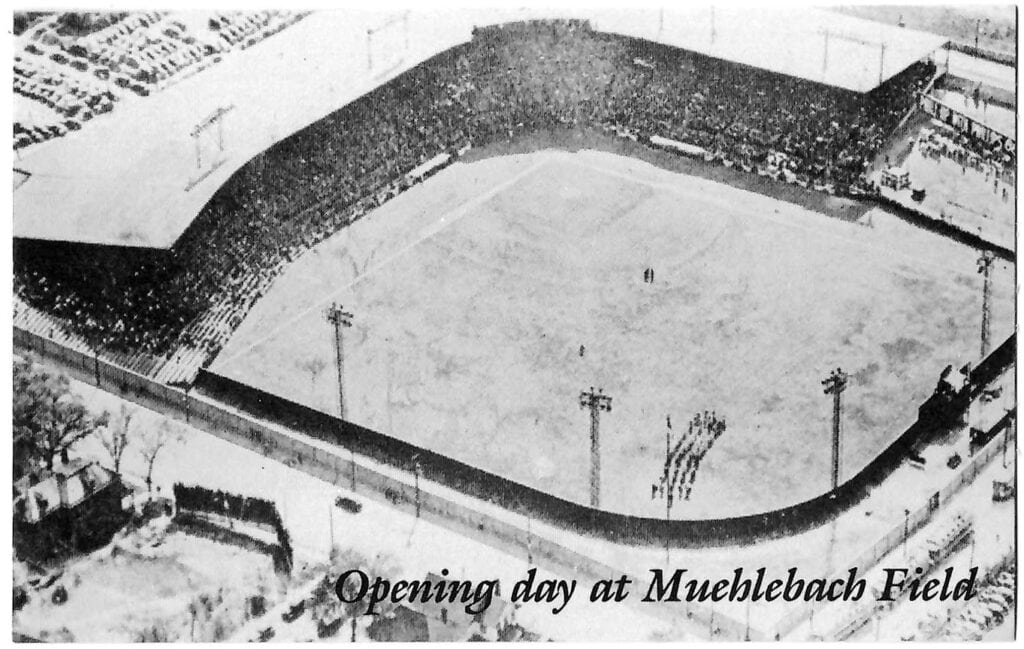
1923: George Muehlebach owned the minor league Kansas City Blues. He also owned the Muehlebach Hotel and bottled Muehlebach beer. In 1923, he built a new baseball stadium at 22nd and Brooklyn to serve as a home field for his Blues and J.L. Wilkinson’s Kansas City Monarchs of the Negro Leagues.
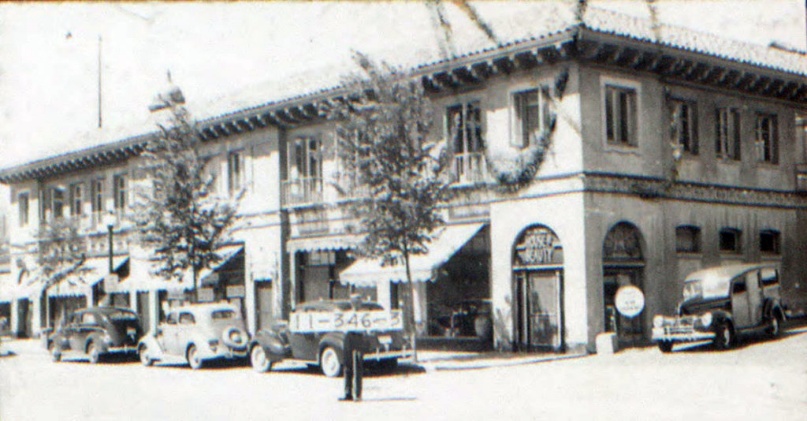
1923: Another Kansas Citian with the initials J.C. (Nichols) inaugurated the Country Club Plaza with the opening of the Mill Street Building.
1925: From 1922 to 1924, contributions from 109,000 people were used to commission a statue of George Washington to be given to the city. The statue, erected on the north side of Pershing Road between Main and Grand, was dedicated on Armistice Day, November 11, 1925. The intent was to name the area Washington Square Park, but there was already a park with that name on the north side of town. The issue was resolved by renaming the older park “Columbus Square Park” in recognition of the large number of Italian immigrants in the area.
1926: On Armistice Day, November 11, 1926, the Liberty Memorial was dedicated (now known as the National WWI Museum and Memorial).
The 1930s – City Hall and Jackson County Courthouse: Presiding Judge Harry Truman led a bond issue campaign that included construction of a downtown courthouse completed in 1933. Across the street, Kansas City completed a new city hall in 1937. Both buildings, constructed with concrete from Tom Pendergast’s Reddy-Mixed Concrete, remain in operation today as anchors of downtown Kansas City.
1944 – A Slogan is Born:
Also in 1944, Harry Truman was selected to be the VP candidate for FDR’s fourth term.
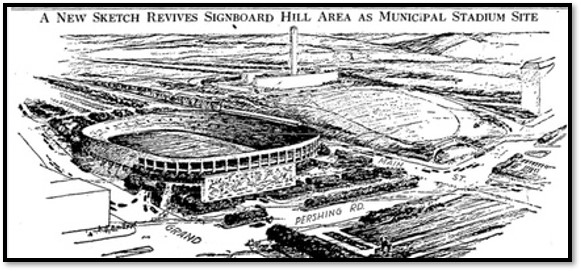
1948 – A Prescient Suggestion: In 1948, architects Keene & Simpson submitted a study of “Signboard Hill” with this sketch of a stadium on the south side of Pershing Road across the street from Washington Square. The city elected not to proceed. The architects were not far off on location (just across the street) but missed the date by 78 years.
In November of 1948, Harry Truman was elected president.
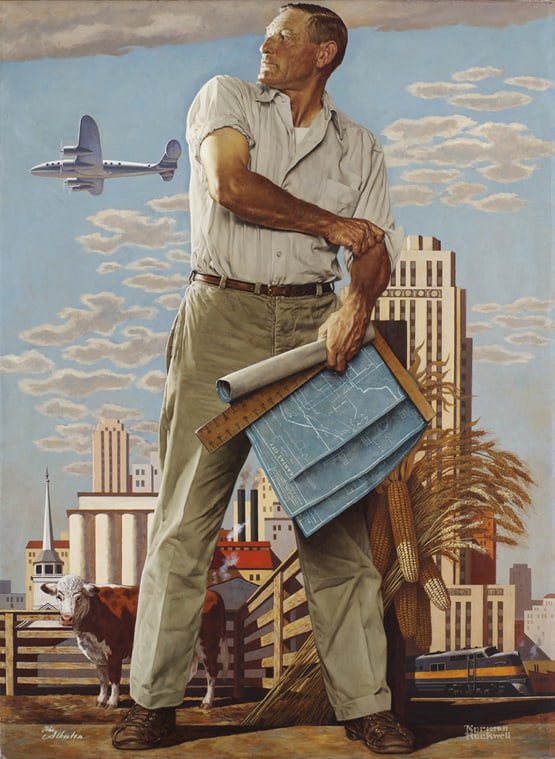
The 1950s – New Logo and Headquarters for Hallmark; Major League Baseball: In July of 1951, there was massive flooding in Kansas City after the floodwalls protecting the West Bottoms failed. J.C. Hall commissioned Norman Rockwell to prepare a painting depicting the rebuilding of the city. Rockwell painted the heroic image of a man with blueprints in hand and recruited painter/illustrator John Atherton to paint the background vista of the city. Titled “The Spirit of Kansas City,” the painting hangs today in Hallmark’s headquarters.
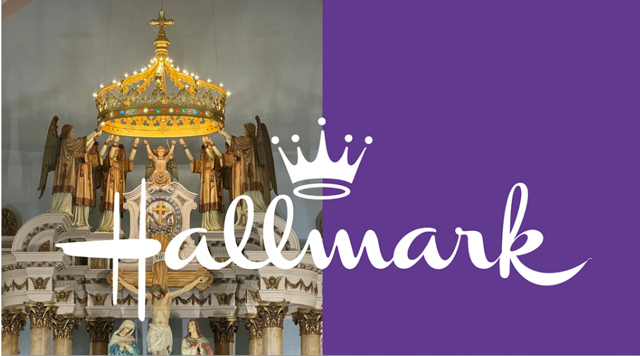
In 1952, Hallmark adopted a new “crowned” logo. A common story about the inspiration for the crown is that Episcopalian J.C. Hall found solace in going to the nearby Our Lady of Sorrows Catholic church to pray. Above the altar at the church, there is a distinctive crown that would have been seen by Hall.
Hallmark’s presence in what we now call the Crown Center area began in 1923 when the company occupied a six-story factory at 26th and Grand. In 1936, to accommodate growth, the headquarters was moved across Grand. The campus continued to grow, and the current headquarters opened in 1956, an eight-story headquarters that is built into the natural contour of the steep hillside (as will be the new stadium).
Another piece of big news from that era was the arrival of major league baseball in 1955. The A’s, relocating from Philadelphia, played at 22nd and Brooklyn where the city financed a complete rebuilding of the stadium built by George Muehlebach in 1923 (including adding a second deck). The stadium was rebranded as Municipal Stadium.
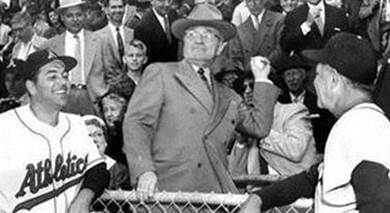
On April 12, 1955, former President Harry Truman threw out the first pitch on opening day. Regular readers of Hot Stove know the two things I will say next. I was 13 at the time and attended the game with my 8th grade pal Jay DeSimone. And Royals owner John Sherman was born that day.
1960s – Birth of Crown Center and the Royals: The dream for Crown Center began percolating in the 1960s. As described on its website:
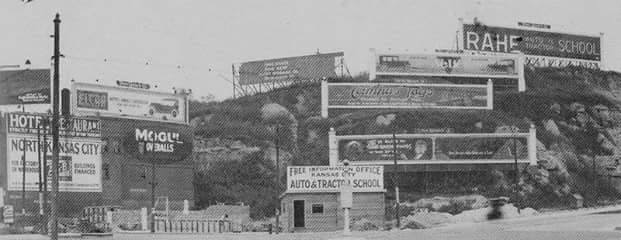
Whatever else Crown Center is, it is the result of the vision of the late Joyce C. Hall, Hallmark Cards, Inc. founder, and his son, longtime Hallmark chairman Donald J. Hall. In the early 1960s, the Halls looked out over the area surrounding their company’s Kansas City headquarters and did not like what they saw: rutted parking lots, abandoned warehouses, the sorry remains of failed or failing businesses, and a limestone hill cluttered with signs and tarpaper shacks. They believed the industry leader in personal expression deserved a better setting for its home – and that the city which had given much to them deserved better than the blighted landscape stretched before them. They had two choices: follow the stream of businesses fleeing the city for the suburbs; or stay and make the city environment better. They chose to stay.
The blighted area was known as Signboard Hill. Hallmark acquired the land and began construction in 1968.
In another blighted situation in the 1960s, the future of baseball was in peril. Charlie Finley was anxious to move the A’s to another city. A new stadium was needed, not just for baseball, but also to provide a better venue for the NFL Chiefs who arrived in KC in 1963. Another set of visionaries – the three administrative judges of the county court – stepped up to the plate to solve the problem.
The judges considered a downtown multi-purpose stadium, but because of legal and electability issues, opted for a large site on the eastern edge of Kansas City. This had the added advantage of providing space for dual stadiums. In 1967, Jackson County voters approved bonds for construction of two stadiums in what would be called the Harry S. Truman Sports Complex.
The promise of a new stadium did not impress Charlie Finley who moved the A’s to Oakland after the 1967 season. After one year without a team, KC returned to MLB when Ewing Kauffman was granted an AL expansion franchise that began play in Municipal Stadium in 1969.
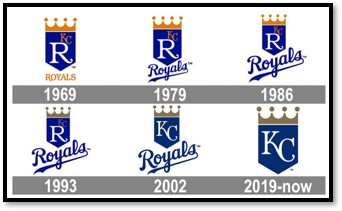
To establish a logo for his new team, Kauffman asked Hallmark to put its artists to work designing a logo. The winning entry was by Shannon Manning, and his basic design has endured to this day.
The 1970s – Big Openings: In 1972, the Chiefs played their first season at Arrowhead.
In April of 1973, the Royals played their first game at Royals Stadium (name changed to Kauffman in 1993).
In May of 1973, the Crown Center hotel and shops opened for business.
The 2000s – Revitalizing Downtown: During the stadium announcement, John Sherman singled out Kay Barnes who served as Kansas City’s mayor from 1999 to 2007. In 2004, Barnes was making the case for an extended vision of “Downtown,” which she was calling River-Crown-Plaza, a six-mile stretch from the Missouri River to the Country Club Plaza, a Mid-American equivalent of the Champs-Elysees in Paris. Kay did her part to get it started. The Power and Light District and the T-Mobile (nee Sprint) Arena provided the spark for a revitalized downtown (with ripple effect to the Crossroads and now Crown Center).
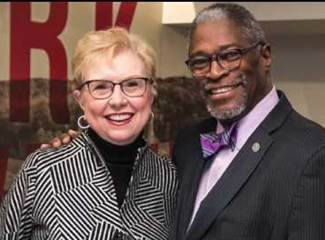
Above, Kay with Sly James who was mayor from 2011 to 2019. On Sly’s watch, Kay’s vision of the connectively of the River Market, Downtown, Crossroads and Crown Center to Midtown and the Plaza was solidified with the passage of bonds for the first leg of the streetcar line in 2012. That first leg ran from the River Market to Union Station and opened in 2016. The second leg from Union Station to UMKC opened in 2025, and the spur to Berkley Riverfront Park and CPKC Stadium will open next month.
2019 – John Sherman and Local Partners Purchase the Royals: From September of 2019…

2020s – Path to a Downtown Stadium: During his presentation last Wednesday, John Sherman joked that the path to a decision was “just like we drew it up.” He was making light of the roadblocks along the way, including a failed election. I won’t do the details, but here are some of the Hot Stove headlines.
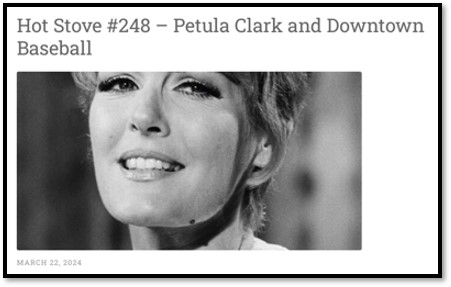

FYI, I am the “aging fanboy” who has a bias for locating baseball stadiums downtown.
2026 – The Very Best Solution: As noted in the beginning of this post, the specific location of the footprint for the stadium was a surprise. It was also a surprise to John Sherman when first suggested to him by Don Hall Jr.
As recounted in a terrific article by Vahe Gregorian in the Kansa City Star, the long-standing relationship between Sherman and Hall was instrumental in the deal. They had worked together on civic and philanthropic endeavors over the years, and Hall was a frequent advisor on the stadium search. He knew Sherman was struggling with issues on the Washington Square site, and maybe even surprising himself, suggested reimagining Crown Center to bring baseball there.
Sherman got this message from Hall in a phone call and says he stood up “to make sure the blood was flowing right, to make sure I heard him right…I had to bring my heart rate back down once I understood he was serious.”
Hall(mark) cared enough to send Sherman the very best.
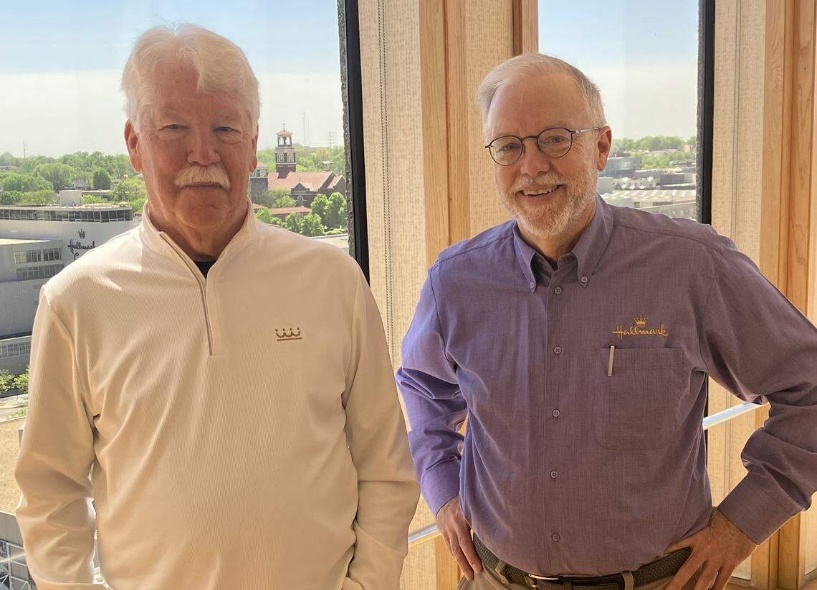
Above is the photo that Vahe took for his story. It’s a “Triple Crown” shot with the Royals and Hallmark crown logos on the shirts and a third crown in the church seen over John’s left shoulder.
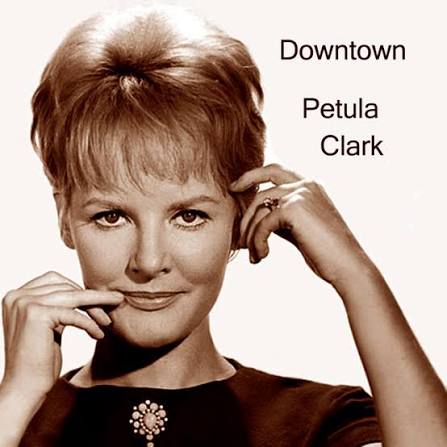
Lonnie’s Jukebox – The Downtown Anthem: I’m not going to do my usual setlist of songs. I’ve talked enough today. But I can’t pass up the opportunity to again feature the cool song celebrating downtown.
“Downtown” by Petula Clark (1964).
Walk-Off Story – Wild About Harry: John Sherman’s busy week continued Thursday night when he and his wife Marny were honorary chairs of the Wild About Harry dinner held at the Muehlebach Hotel. This is an annual fundraiser for the Truman Library and drew a sold-out crowd of 900. The honoree of the evening (and keynote speaker) was David Rubenstein, a co-founder of the Carlyle Group and known for his “patriotic philanthropy,” working to preserve the places and stories that define our national identity.
Rubenstein also owns the Baltimore Orioles. Coincidentally, the Orioles and Royals played a three-game series last week and Sherman lamented during his introduction that the Royals had lost two out of the three games.
There is currently a major exhibit at the Truman Library of original documents from the National Archives (“Opening the Vault: The Story of Us”). Webpage here and 2-minute video by David Von Drehle here. Exhibit ends May 24.
For the last several years at Wild About Harry, guests can get a green screen photo that puts them in a scene with President Truman. Rita and I have photos with Truman in front of the White House, in the Oval Office, with President Kennedy and on the presidential yacht. This year, we could pick from three scenes, and we had an easy choice.
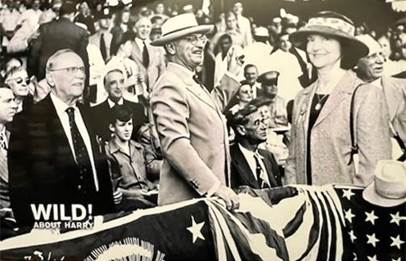
The original photo is from September 8, 1945, six days after Japan surrendered. The last time a president had had thrown a first pitch was Franklin Roosevelt on April 14, 1941. Then WWII intervened. Truman knew his presence at Griffith Stadum was a welcome signal that the country was returning to normal. For cool newsreel footage of Truman’s pitch, click here.
Walk-Off – For Real: The Royals celebrated the stadium announcement by sweeping the Angels in a weekend series, winning the third game last night on a walk-off homer by Lane Thomas in the 10th inning.
Go Royals!
Go Crown Center!
This electronic mail message contains CONFIDENTIAL information which is (a) ATTORNEY – CLIENT PRIVILEGED COMMUNICATION, WORK PRODUCT, PROPRIETARY IN NATURE, OR OTHERWISE PROTECTED BY LAW FROM DISCLOSURE, and (b) intended only for the use of the Addressee(s) named herein. If you are not an Addressee, or the person responsible for delivering this to an Addressee, you are hereby notified that reading, copying, or distributing this message is prohibited. If you have received this electronic mail message in error, please reply to the sender and take the steps necessary to delete the message completely from your computer system.